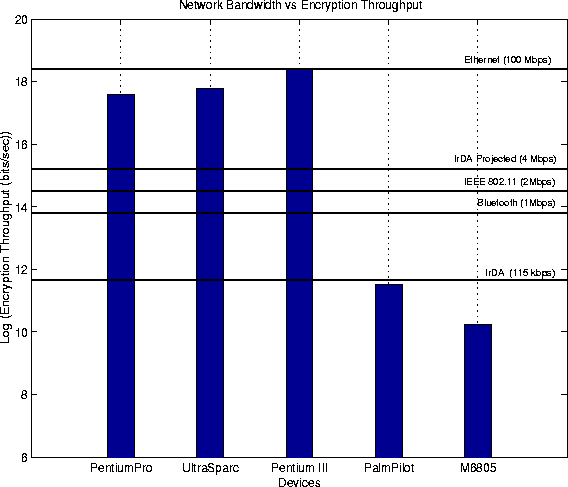
From the graph in Figure 2, we see that a PalmPilot can sustain an encryption throughput of 100 kbps while a Pentium III can sustain a throughput of 98.4 Mbps. Hence, while encryption speeds on a Pentium III can match the Bluetooth bandwidth of 1 Mbps, the same cannot be said of the PalmPilot which can barely manage the IrDA bandwidth of 115 kbps.
Thus, the general trend that emerges is that the state of the art PCs and high end workstations can very easily cope with data rates on almost any kind of network. However, encryption rates on handheld devices and PDAs, may in general not be able to match the network rates. However, in order to make a conclusive statement on the feasibility of universal encryption, we need to perform application specific studies. In cases where the expected data rates are much lower than the network speeds, the encryption rate that can be sustained may be acceptable .