A convex hull is the smallest convex polygon that will enclose a set of points. In a convex polygon a line joining any two points in the polygon will lie completely within the polygon. One way to visualize a convex hull is as follows: imagine there are nails sticking out over the distribution of points. Place a rubber band such that it encircles all the nails. The figure described by the rubber band is a convex hull.
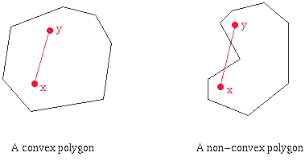
Input: The input will be a file called points.txt. The first line will be a single integer n denoting the number of points, where n will be in the range 3 to 100 inclusive. It will be followed by n lines of data. Each line will have the x and y coordinates of a point. The coordinates of the points will be integers in the range (-200, 200).
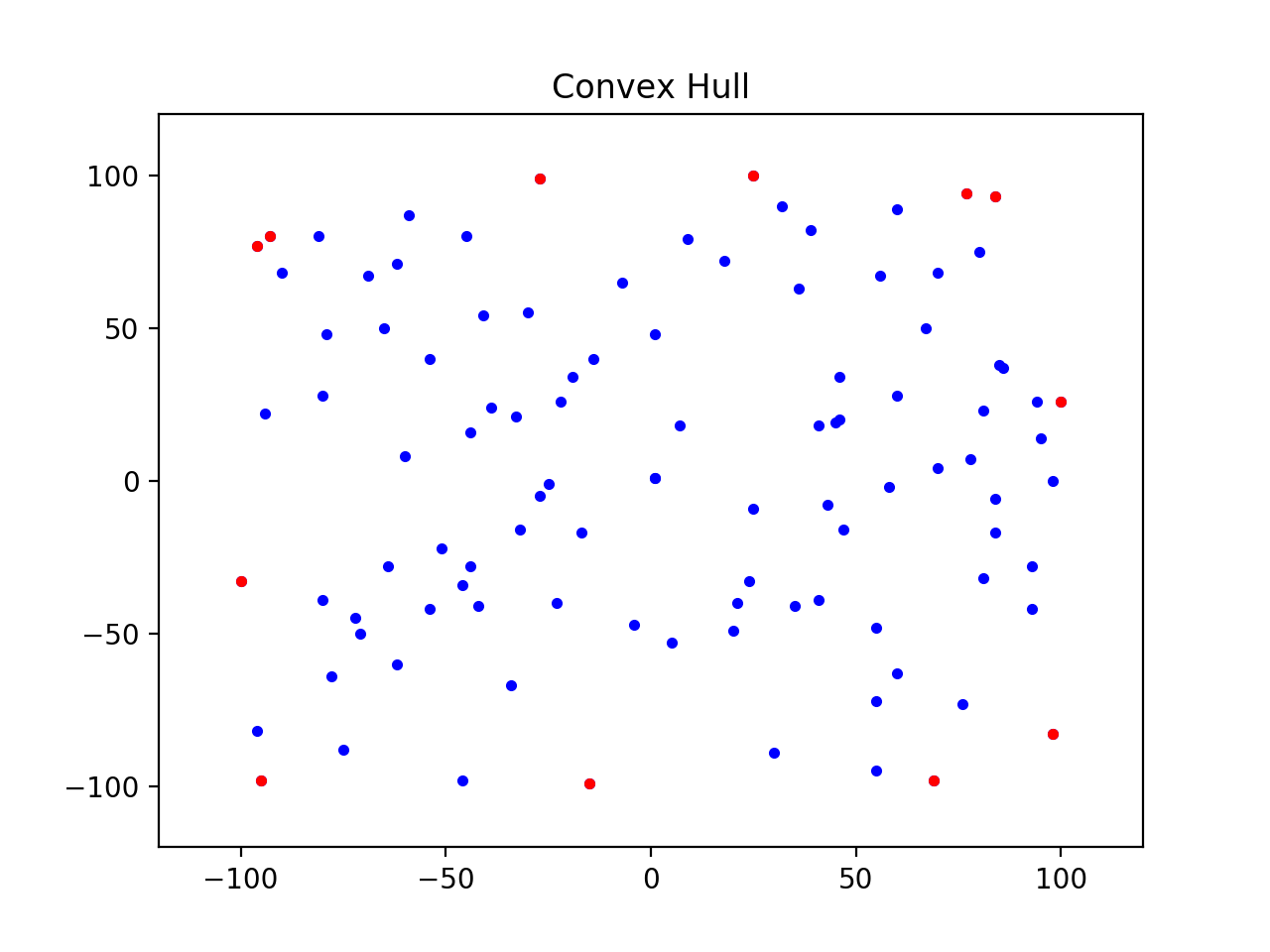
Output: For the input file given you will print the vertices of
the convex hull starting at the extreme left point and going clockwise
around the convex hull. The output for this input file is:
Convex Hull
(-100, -33)
(-96, 77)
(-93, 80)
(-27, 99)
(25, 100)
(77, 94)
(84, 93)
(100, 26)
(98, -83)
(69, -98)
(-15, -99)
(-95, -98)

Area of Convex Hull = 37218.0
There are many algorithms for solving the convex hull problem. You will have to implement the Graham's scan algorithm that is of order O(n log n). The algorithm is given to you in pseudo code.
Input: A set of point objects in the x-y plane.

Output: A list of point objects that define the vertices of the convex
        hull in clockwise order.

1.  Sort the points by x-coordinates resulting in a sorted sequence
    p1 ... pn.

2.  Create an empty list upper_hull that will store the vertices
    in the upper hull.

3.  Append the first two points p1 and p2 in order into the upper_hull.

4.  For i going from 3 to n

5.    Append pi to upper_hull.

6.    While upper_hull contains three or more points and the last three
      points in upper_hull do not make a right turn do

7.      Delete the middle of the last three points from upper_hull

8.  Create an empty list lower_hull that will store the vertices
    in the lower hull.

9.  Append the last two points pn and pn-1 in order into lower_hull with
    pn as the first point.

10. For i going from n - 2 downto 1

11.   Append pi to lower_hull

12.   While lower_hull contains three or more points and the last three
      points in the lower_hull do not make a right turn do

13.     Delete the middle of the last three points from lower_hull

14. Remove the first and last points for lower_hull to avoid duplication
    with points in the upper hull.

15. Append lower_hull to upper_hull and call it the convex_hull

16. Return the convex_hull.
Two points p (px, py) and q (qx, qy) define a straight line. If add a third point r (rx, ry) how do you know whether r is to the right or left of the line defined by p and q. There is a simple solution to it. Evaluate the following determinant:
1   px   py
1   qx   qy
1   rx   ry
If the determinant is zero then the three points are in a straight line. The sign of the determinant will decide if the point is to the right or left of the line. Find that for yourself.
The computation of the area of a polygon given its vertices involves computing another determinant. If the vertices of a polygon are given by [p1, p2, ..., pn] where n is greater than or equal to 3, then compute the determinant given by the coordinates of the vertices:
x1  y1
x2  y2
..  ..
xn  yn

det = (x1 * y2 + x2 * y3 + ... + xn * y1 - y1 * x2 - y2 * x3 - ... - yn * x1)

area = (1/2) * abs (det)
You must follow the template of the code given. You may not change the function signature but you may always add helper functions as needed.
import math

class Point (object):
  # constructor
  def __init__(self, x = 0, y = 0):
    self.x = x
    self.y = y

  # get the distance to another Point object
  def dist (self, other):
    return math.hypot (self.x - other.x, self.y - other.y)

  # string representation of a Point
  def __str__ (self):
    return '(' + str(self.x) + ', ' + str(self.y) + ')'

  # equality tests of two Points
  def __eq__ (self, other):
    tol = 1.0e-8
    return ((abs(self.x - other.x) < tol) and (abs(self.y - other.y) < tol))

  def __ne__ (self, other):
    tol = 1.0e-8
    return ((abs(self.x - other.x) >= tol) or (abs(self.y - other.y) >= tol))

  def __lt__ (self, other):
    tol = 1.0e-8
    if (abs(self.x - other.x) < tol):
      if (abs(self.y - other.y) < tol):
        return False
      else:
        return (self.y < other.y)
    return (self.x < other.x)

  def __le__ (self, other):
    tol = 1.0e-8
    if (abs(self.x - other.x) < tol):
      if (abs(self.y - other.y) < tol):
        return True
      else:
        return (self.y <= other.y)
    return (self.x <= other.x)

  def __gt__ (self, other):
    tol = 1.0e-8
    if (abs(self.x - other.x) < tol):
      if (abs(self.y - other.y) < tol):
        return False
      else:
        return (self.y > other.y)
    return (self.x > other.x)

  def __ge__ (self, other):
    tol = 1.0e-8
    if (abs(self.x - other.x) < tol):
      if (abs(self.y - other.y) < tol):
        return True
      else:
        return (self.y >= other.y)
    return (self.x >= other.x)

# compute and return the determinant of the coordinates of three points
# p, q, and r are Point objects
def det (p, q, r):

# computes and returns the convex hull of a sorted list of Points
# convex hull is a list of Point objects starting at the extreme
# left point and going clockwise in order
def convex_hull (sorted_points):

# compute and return the area of a convex polygon
# convex_poly is a list of Point objects that define the vertices
# of a convex polygon in order
def area_poly (convex_poly):

def main():
  # create an empty list of Point objects

  # open file points.txt for reading

  # read file line by line, create Point objects and store in a list

  # sort the list according to x-coordinates

  # get the convex hull

  # print the convex hull

  # get the area of the convex hull

  # print the area of the convex hull

# YOU MUST WRITE THIS LINE AS IS
if __name__ == "__main__":
  main()
For this assignment you may work with a partner. Both of you must read the paper on Pair Programming. .
We will be looking at documentation, descriptive variable and function names, clean logical structure, and adherence to the coding conventions discussed in class. The file will have a header of the following form:
#  File: ConvexHull.py

#  Description:

#  Student Name:

#  Student UT EID:

#  Partner Name:

#  Partner UT EID:

#  Course Name: CS 313E

#  Unique Number:

#  Date Created:

#  Date Last Modified:
If you are working with a partner both of you will be submitting the same program from both accounts but make sure that you have your partner's name and eid in your program. If you are working alone, then remove the two lines that has the partner's name and eid in the header.
Use the Canvas system to to submit your ConvexHull.py file. We should receive your work by 11 PM on Friday, 27 Sep 2019. There will be substantial penalties if you do not adhere to the guidelines. Remember Python is case sensitive. The name of your file must match exactly what we have specified.