CS 312 Assignment 12 - Guitar Hero - Classes,
Objects, Arrays
Programming Assignment 12: Individual Assignment. You must complete this assignment by yourself. You cannot work with anyone else in the class or with someone outside of the class. You are encouraged to get help from the instructional staff. Recall we will check submissions with plagiarism detection software. If you copy code from someone else or the web you will be subject to the penalties for academic dishonesty.
Placed online: Tuesday, April 26
20 points, ~2% of total grade
Due: no later than 11 pm, Friday, May 6. You may not use any slip days on assignment. Late submissions shall not be accepted.
Many Thanks to Kevin Wayne of Princeton University and Andrew Appel, Jeff Bernstein, Maia Ginsburg, Ken Steiglitz, Ge Wang for allowing me to use this assignment.
Provided Files: There are multiple support files you will have to download from the assignment web page.
Keyboard.java This class is complete. It display the UI (user interface) and responds to the user pressing keys on the physical keyboard and mouse clicks on the UI itself. Look at how the Keyboard object is created and used in the given GuitarHeroLite.java class and use that approach in the GuitarHero class you create.
StdAudio.java - Used to play sounds. You should not have to change any of the calls to this class or call any other methods. If interested, here is the documentation
GuitarHeroLite.java - A class that creates a GUI and allows the user to "pluck" two guitar strings by pressing the 'a' or 'c' key on the keyboard. This class will not work until you complete the GuitarString and RingBuffer classes. Implement a GuitarHero.java class similar to GuitarHeroLite, but your class will support 37 strings, not just 2.
RingBufferTester.java - Simple tests for your RingBuffer class.
Sample output. An audio file (mp3 format) with sample sounds based on the suggested solution. You can also view a recording on the Canvas course page for a video demonstrating the finished program.
Purpose: The purposes of this assignment are:
You must use a native array of doubles as an instance variable for your RingBuffer class.
Background:
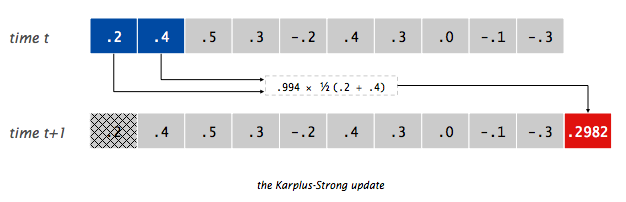
Write a program to simulate plucking a guitar string using the Karplus-Strong algorithm. This algorithm played a seminal role in the emergence of physically modeled sound synthesis (where a physical description of a musical instrument is used to synthesize sound electronically).
Simulate the plucking of a guitar string. When a guitar string is plucked, the string vibrates and creates sound. The length of the string determines its fundamental frequency of vibration. We model a guitar string by sampling its displacement (a real number between -1/2 and +1/2) at N equally spaced points (in time), where N equals the sampling rate (44,100) divided by the fundamental frequency (rounding the quotient up to the nearest integer).
Why it works? The two primary components that make the Karplus-Strong algorithm work are the ring buffer feedback mechanism and the averaging operation.
From a mathematical physics viewpoint, the Karplus-Strong algorithm approximately solves the 1D wave equation, which describes the transverse motion of the string as a function of time.
Classes to Implement:
RingBuffer: A RingBuffer (also known as a buffered queue) is a data structure (variable that stores other variables) that allows access to the item that has been in the data structure the longest amount of time.
A queue is similar to a line (like the line at Starbucks's in the Student Union or Chick-fil-A at the SAC)
Your first task is to create a class to model a ring buffer.
Write a
class named RingBuffer that implements the following methods: (All
methods are public!). You must use a native array of doubles (double[])
to store the elements of the RingBuffer.
public class RingBuffer
-----------------------------------------------------------------------------------------
        RingBuffer(int capacity)  // create an empty ring buffer, with given max capacity
    int size()                    // return number of items currently in the buffer
boolean isEmpty()                 // is the buffer empty (size equals zero)?
boolean isFull()                  // is the buffer full  (size equals capacity)?
   void enqueue(double x)         // add item x to the end (as long as the buffer is not full)
 double dequeue()                 // delete and return item from the front (as long as the buffer is not empty)
 double peek()                    // return (but do not delete) item from the front of the buffer
 String toString()                // override toString. Return a String of the form [front, next, next, last]
RingBuffer shall throw a NoSuchElementException if the client attempts to
dequeue() from or peek() at an empty buffer and a
IllegalStateException if enqueue(double val) is called
when the buffer is full.
Here is an example of the code to throw an exception. You shall do this extensively in CS314.
public double peek() {
    if (isEmpty()) {

throw new NoSuchElementException("Cannot call peek on an empty RingBuffer.");

}
    /* The code for peek to do its job.

We now know the RingBuffer isn't empty and we have a front or first element to
return. */
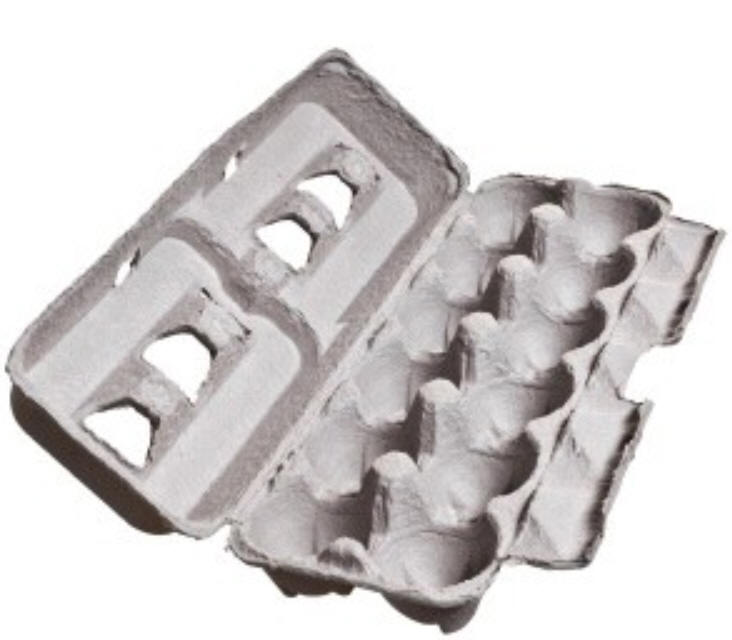
Be clear on the difference between the RingBuffer's capacity and its size. The capacity is fixed and doesn't change. It's like spots we could store values. For example the capacity of this egg carton is 12, but its size (number of eggs present is 0):
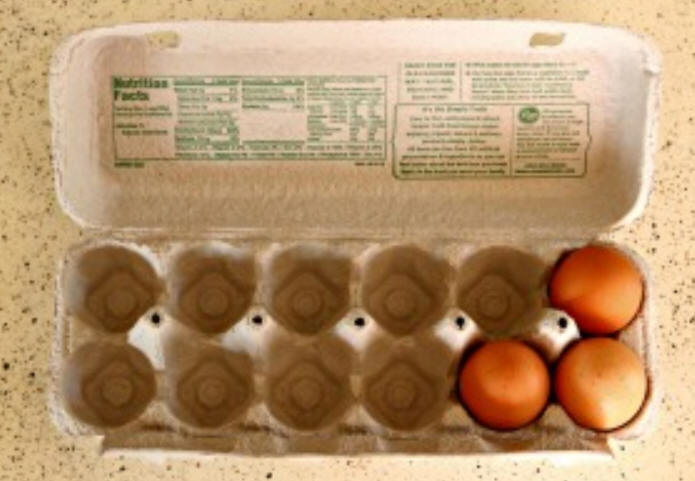
This egg carton also has a capacity of 12, but its size is 3 because it currently contains 3 eggs:
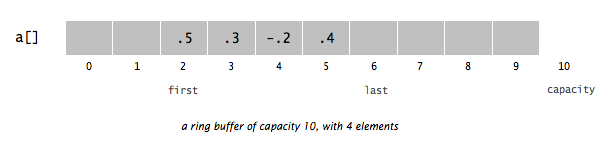
Since the ring buffer has a known maximum capacity, implement it using an array of doubles of that length. For efficiency, use cyclic wrap-around: Maintain one integer instance variable first that stores the index of the item that has been in the RingBuffer the longest. (The front of the line.) Maintain a second integer instance variable last that stores the index one beyond the most recently inserted item. To insert an item, put it at index last and increment last. To remove an item, take it from index first and increment first. When either index equals capacity, make it wrap-around by changing the index to 0.
Note, do not shift elements (change position) in the array during any of the operations. Doing so will cause your buffer to be very slow and cause incorrect audio output.
Consider this series of operations on a RingBuffer of capacity 4.
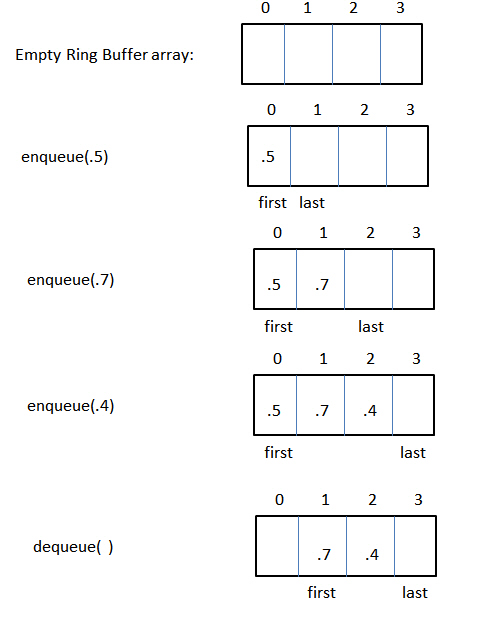
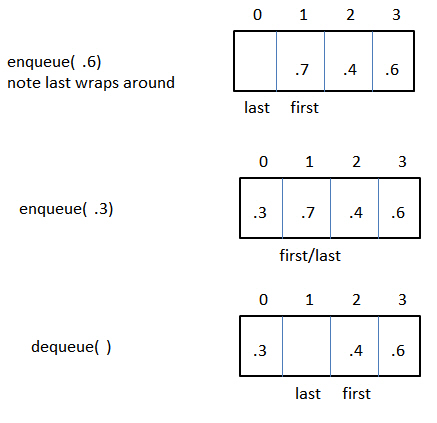
Since the ring buffer has a known maximum capacity, you can implement it
using a double array of that length. For efficiency, use cyclic wrap-around:
maintain an integer instance variable first that stores the index of the least
recently inserted item and a second integer instance variable last that stores
the index one beyond the most recently inserted item.
To insert an item,
put it at index last and increment last. To remove an item, take it from index
first and increment first. When the value of either index (last, first) equals
capacity, make it wrap-around by changing the index to 0. To determine the
current number of valid entries in the ring buffer (and whether it is full or
empty), you will also need a third integer instance variable size.
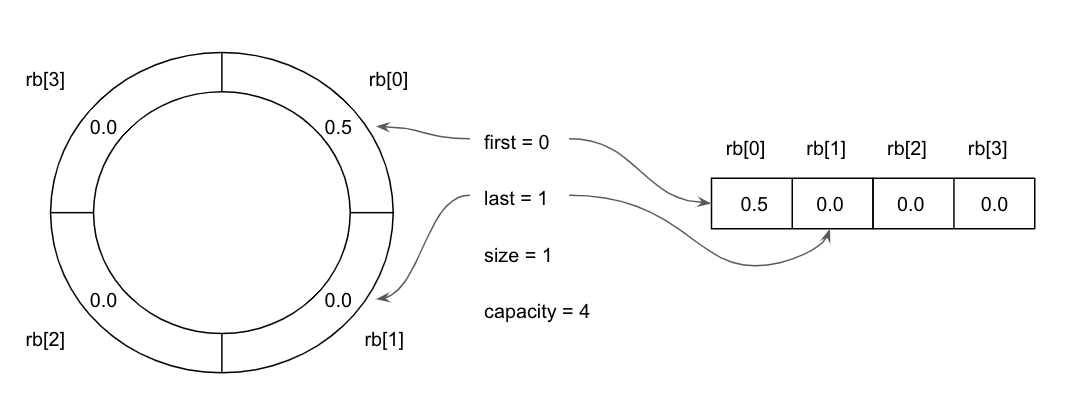
Illustrating the double array as a ring, (thus RingBugffer)
helps understand the operation of the ring buffer. For example, the diagram
below shows a ring buffer with a capacity of four (4), containing a single
value.
You can use the RingBufferTester class to see if your RingBuffer works. Do this before going on to the next class! Note, you may pass all the tests in RingBufferTester, but still have errors in your RingBuffer. (Recall failing tests proves the presence of a bug, but passing all tests does NOT prove the absence of bugs unless you test every possible condition, which is normally impractical or even impossible.)
GuitarString:
Next, create a data type to model a vibrating guitar string. Write a class named GuitarString that implements the following API: (All methods are public!)
public class GuitarString
------------------------------------------------------------------------------------------------------------------------
       GuitarString(double frequency)  // create a guitar string of the given frequency, using a sampling rate of 44,100
       GuitarString(double[] init)     // create a guitar string whose size and initial values are given by the array
  void pluck()                         // set the buffer to white noise
  void tic()                           // advance the simulation one time step
double sample()                        // return the current sample
   int time()                          // return number of tics
Interactive guitar player. GuitarHeroLite.java is a sample GuitarString client that plays the guitar in real-time, using the keyboard to input notes. When the user types the lowercase letter 'a' or 'c', the program plucks the corresponding string. Since the combined result of several sound waves is the superposition of the individual sound waves, we play the sum of all string samples.
Write a program GuitarHero that is similar to GuitarHeroLite, but supports a total of 37 notes on the chromatic scale from 110Hz to 880Hz. In general, make the ith character of the string below play the i note.
String keyboard = "q2we4r5ty7u8i9op-[=zxdcfvgbnjmk,.;/' "; // String ends with a space
This keyboard arrangement imitates a piano keyboard: The "white keys" are on the qwerty and zxcv rows and the "black keys" on the 12345 and asdf rows of the keyboard.
The ith character of the string corresponds to a frequency of 440 × 1.05956(i - 24), so that the character 'q' is approximately 110Hz, 'i' is close to 220Hz, 'v' is close to 440Hz, and ' ' is close to 880Hz.
Style: As always, use good style in your classes and methods. If you have3 or more GuitarStrings would you even THINK about using 3 separate GuitarString variables? Use the String indexOf method to map from the String representing the keys on the keyboard to your array of GuitarString variables.
Checklist: Did you remember to: