




There are two common ways to tie the standard shoelace bow. One produces a square, or “reef,” knot; the other produces a less stable “granny” knot. The reef knot is believed to be more resistant to accidental untying.
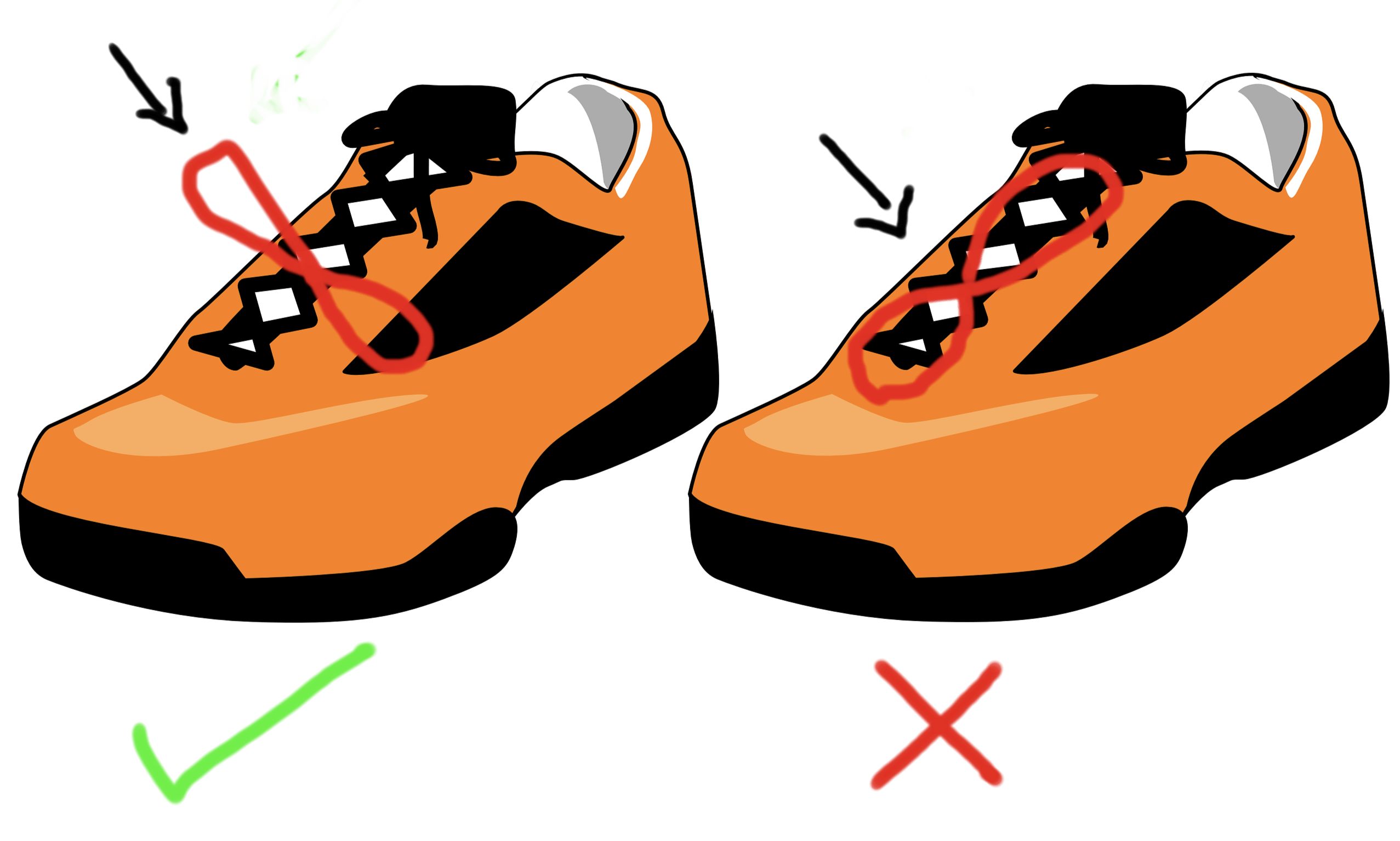
I decided to test that belief. I tied the laces on my two shoes differently. For the first two weeks, I used the “good” knot on my right shoe and the “bad” knot on my left. Whenever a lace came undone, I recorded whether it was the left or right one. I then repeated the experiment with the knots switched: good on the left, bad on the right. Switching sides reduced the chance that any difference was simply caused by how I move my feet—I am right-handed.
The observations were:
Good knot on left shoe: R R R R L L R
If both knots were equally likely to come undone, the probability of seeing results at least this favorable to the good knot is approximately 0.014 in a one-sided hypothesis test. The experiment therefore provides reasonable statistical evidence that the good knot is, in fact, more reliable.
There are important limitations. The sample is small, and it contains only one subject: me. I did not control for every possible confounding factor. Perhaps I tie the good knot more carefully, or perhaps the outcome would be different for someone else. One helpful feature is that the tying was often blind. I did not know how to tie my laces, and had to use trial-and-error. Thus, I often did not know which knot I had produced until I finished tying it. I was therefore unlikely to deliberately tighten the good knot more.
A more systematic investigation of how shoelace knots fail appears in Daily-Diamond, Gregg, and O'Reilly, “The roles of impact and inertia in the failure of a shoelace knot” (2017).