




I want to make a playful argument that we drink water as a source of energy. Along the way, we will see how a difference in concentration can produce useful work, why alcohol can be dehydrating even though it contains plenty of water, why some desert rodents excrete nearly crystalline waste, and why drinking urine does not quench thirst.
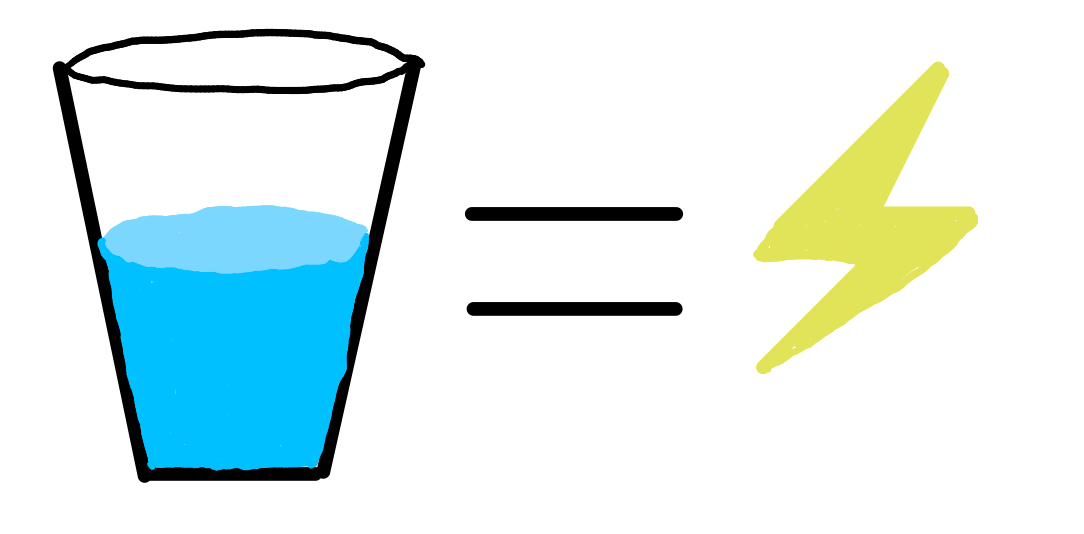
Can water generate energy?
Yes—provided we have two bodies of water containing different concentrations of dissolved material. In the human body, the water we drink is relatively dilute, while our internal fluids are comparatively “salty.”
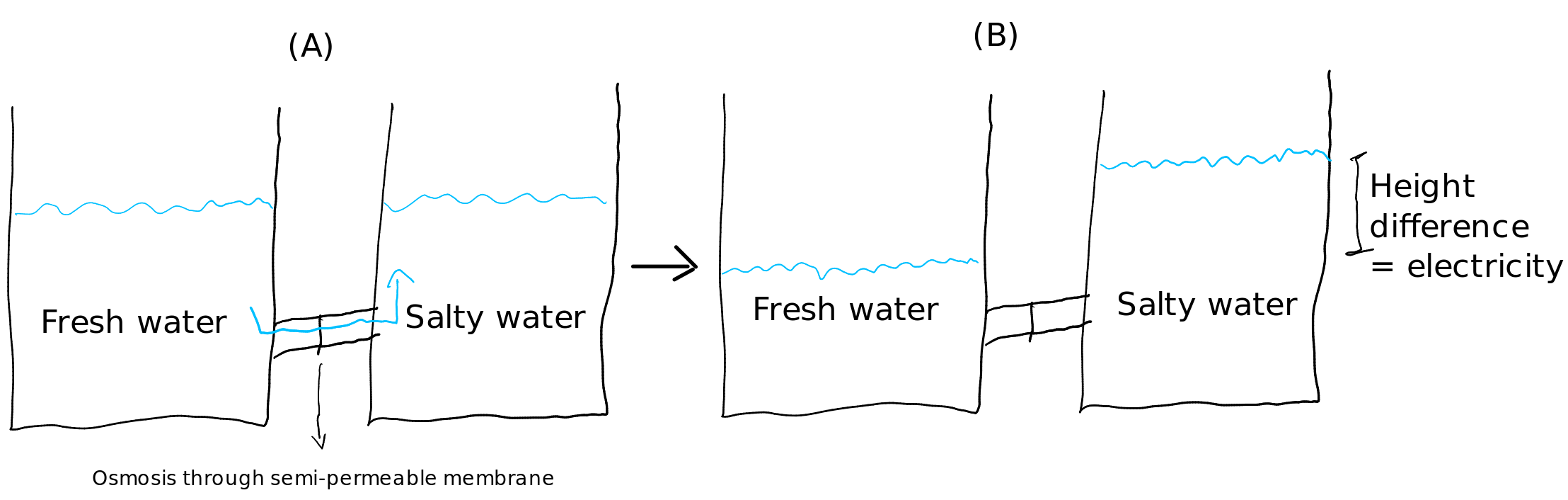
Imagine a glass of pure water and a glass of salt water. Mixing them increases the entropy of the combined system, and some of that change can be converted into useful work. Consider a hypothetical engine connecting the glasses with a semipermeable membrane that allows water, but not salt, to pass through. Osmosis moves water from the dilute side to the salty side. The water level on the salty side rises, turning part of the concentration difference into gravitational potential energy. Letting that water flow back through a turbine could produce a tiny amount of electricity.
The water–energy trade-off
Does the body actually extract energy from drinking water? Not directly—but, in a useful sense, water allows the body to save energy.
We drink water partly so that we can remove waste products in urine. With less water available, the kidneys must spend more energy concentrating that waste. Different animals make different trade-offs. Reptiles generally produce relatively dilute waste while expending little energy on concentration. Mammals and some birds can make urine more concentrated than their blood, conserving water at an energetic cost.1 Some desert rodents concentrate their urine so dramatically that dissolved material can crystallize. Humans usually have easier access to fresh water and do not need to go that far. We can spend the energy we save on other pursuits—such as writing essays about how drinking water saves energy.
Our bodies do not work exactly like the two-reservoir engine. If we kept separate reservoirs of blood and pure water, a simple kidney could be a membrane permeable only to substances we want to remove, such as urea. Those substances would diffuse into the fresh water, which could then leave the body as urine.2 Instead, the water we drink enters the bloodstream, and the kidneys later filter the blood. Even so, having more water available to discard in urine reduces the energy required to eliminate waste.
The mechanism
How do the kidneys spend energy to concentrate urine? Much of the process depends on the loop of Henle. This structure contains fluid that will eventually become urine. Along one part of the loop, cells use ATP to transport salt from that fluid into the surrounding kidney tissue. The resulting concentration gradient then draws water out of another part of the loop through osmosis. Producing more concentrated urine generally requires maintaining a stronger gradient, which consumes energy.
Conclusion
Our bodies already contain plenty of H2O; what we continually need is water that is sufficiently dilute. That is why salt water, urine, and sufficiently concentrated alcoholic drinks cannot replace fresh water. Their dissolved substances limit—or reverse—the benefit.
Dilute water contains usable potential because its concentration differs from that of our body fluids. The kidneys use that difference to remove waste while spending less ATP than they otherwise would. So, in this deliberately unconventional sense, drinking water saves calories.
Disclaimer: This is a thermodynamic way to think about one role of water in the body, not medical or dietary advice. Human physiology is more complicated than what a short essay by a computer scientist, looking primarily to entertain himself, can capture.
- Eldon J. Braun, “Comparative renal function in reptiles, birds, and mammals,” Seminars in Avian and Exotic Pet Medicine 7, no. 2 (1998).
- In this hypothetical design, urine could not become more concentrated than blood. The same is true of reptiles, even though they do not have a separate fresh-water reservoir.