#include <ast.h>
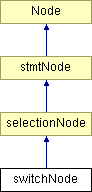
Inheritance diagram for switchNode::
Public Methods | |
| switchNode (exprNode *expr, stmtNode *stmt, const Coord coord=Coord::Unknown) | |
| Create a new switch statement. More... | |
| virtual | ~switchNode () |
| Destroy a switchNode. More... | |
| virtual void | dataflow (FlowVal *v, FlowProblem &fp) |
| Run the dataflow analyzer. More... | |
| virtual Node * | clone () const |
| Clone the input node. More... | |
| virtual void | output_stmt (output_context &ct, Node *par) |
| Output a statement. More... | |
Accessors | |
Methods to get and set fields in the class. | |
| target_list & | cases () |
| const target_list & | cases () const |
| bool | has_default () const |
| void | has_default (bool has_default) |
| FlowVal * | at_top () const |
| void | at_top (FlowVal *at) |
AST Traversal | |
| virtual void | visit (Visitor *the_visitor) |
| Dispatch a Visitor. More... | |
| virtual void | walk (Walker &the_walker) |
| Dispatch a Walker. More... | |
| virtual Node * | change (Changer &the_changer, bool redispatch=false) |
| Dispatch a Changer. More... | |
Private Attributes | |
| REF target_list | _cases |
| the list of cases. More... | |
| bool | _has_default |
| a flag that is true if the switch has a default case. More... | |
| FlowVal * | _at_top |
| dataflow analysis entry value. More... | |
This class represents the switch statement. The child statement is typically a compound statement containing the cases. All cases should be contained somewhere in that subtree, although there is currently no check for this. It contains a list of the cases (including the default) that are within its scope. This list is initially empty, but is computed after parsing by the set_container_walker.
The NodeType is Switch.
|
||||||||||||||||
|
Create a new switch statement. The new switch statement has the given selection expression and the child statement that should contain the cases.
|
|
|
Destroy a switchNode.
|
|
|
|
|
|
|
|
|
|
|
|
|
|
||||||||||||
|
Dispatch a Changer. This abstract method works much the walker, but allows the tree to be changed.
Reimplemented from Node. |
|
|
Clone the input node. This is not a "deep" clone, so be careful. For a deep clone, use the clone_changer class.
Reimplemented from Node. |
|
||||||||||||
|
Run the dataflow analyzer. Each subclass overrides this method to define it's semantics for dataflow analysis. It alters the input flow value to reflect the effect of the node within the given flow problem, calling dataflow() on it's subtrees as necessary. See the dataflow analysis documentation for more information.
Reimplemented from Node. |
|
|
|
|
|
|
|
||||||||||||
|
Output a statement.
Reimplemented from stmtNode. |
|
|
Dispatch a Visitor. This abstract method is the entry point for the visitor design pattern. Each node subclass defines a visit() method that calls the appropriate at_ method in the visitor. For more information see the Visitor documentation.
Reimplemented from Node. |
|
|
Dispatch a Walker. This abstract method works much like the visitor, but instead walks the entire underlying subtree calling the appropriate at_ method at each node. For more information see the Walker documentation.
Reimplemented from Node. |
|
|
dataflow analysis entry value. This field is used by the dataflow analysis framework to hold the incoming flow value needed by each case statement. |
|
|
the list of cases. This list includes the default case. It is initially empty, but is computer after parsing by the set_container_walker. |
|
|
a flag that is true if the switch has a default case.
|
 1.2.13.1 written by Dimitri van Heesch,
© 1997-2001
1.2.13.1 written by Dimitri van Heesch,
© 1997-2001