#include <ast.h>
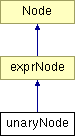
Inheritance diagram for unaryNode::
Public Methods | |
| unaryNode (unsigned int op_id, exprNode *expr, const Coord coord=Coord::Unknown) | |
| Create a new unary expression. More... | |
| unaryNode (unsigned int op_id, typeNode *the_type, const Coord coord=Coord::Unknown) | |
| Create a sizeof expression. More... | |
| virtual | ~unaryNode () |
| Destroy a unaryNode. More... | |
| virtual void | eval () |
| Constant expression evaluator. More... | |
| virtual void | dataflow (FlowVal *v, FlowProblem &fp) |
| Run the dataflow analyzer. More... | |
| virtual Node * | clone () const |
| Clone the input node. More... | |
| virtual void | output_expr (output_context &ct, Node *par, int prec, Assoc assoc) |
| Output a expression. More... | |
| virtual int | precedence (Assoc &assoc) |
| Associativity and precedence. More... | |
Accessors | |
Methods to get and set fields in the class. | |
| Operator * | op () const |
| void | op (Operator *op) |
| exprNode * | expr () const |
| exprNode * | get_expr () |
| void | expr (exprNode *expr) |
| typeNode * | sizeof_type () const |
| typeNode * | get_sizeof_type () |
| void | sizeof_type (typeNode *sizeof_type) |
AST Traversal | |
| virtual void | visit (Visitor *the_visitor) |
| Dispatch a Visitor. More... | |
| virtual void | walk (Walker &the_walker) |
| Dispatch a Walker. More... | |
| virtual Node * | change (Changer &the_changer, bool redispatch=false) |
| Dispatch a Changer. More... | |
Private Attributes | |
| Operator * | _op |
| the operator. More... | |
| TREE exprNode * | _expr |
| the sub-expression. More... | |
| TREE typeNode * | _sizeof_type |
| the sizeof type. More... | |
This class represents most expression with one argument (unary operator expressions).
The NodeType is Unary.
|
||||||||||||||||
|
Create a new unary expression. The new expression has the given operator and subexpression. The operator is given using its identifier from the parser. For most operators, this is simply the char representation. For example, we pass '+' to get the addition operator. For ambiguous operators and multiple-character operators, you need to look up the proper identifier in the Operators table.
|
|
||||||||||||||||
|
Create a sizeof expression. This constructor differs in that it takes a type as the subexpression.
|
|
|
Destroy a unaryNode.
|
|
||||||||||||
|
Dispatch a Changer. This abstract method works much the walker, but allows the tree to be changed.
Reimplemented from Node. |
|
|
Clone the input node. This is not a "deep" clone, so be careful. For a deep clone, use the clone_changer class.
Reimplemented from Node. |
|
||||||||||||
|
Run the dataflow analyzer. Each subclass overrides this method to define it's semantics for dataflow analysis. It alters the input flow value to reflect the effect of the node within the given flow problem, calling dataflow() on it's subtrees as necessary. See the dataflow analysis documentation for more information.
Reimplemented from Node. |
|
|
Constant expression evaluator. This method attempts to evaluate an expression at compile-time. This only yields a meaningful value when the leaves of the given expression are constants, enums, or other compile-time values (e.g., sizeof). The resulting value is stored on each exprNode, in the _value field. Each exprNode sublcass implements this method, calling it recursively when necessary. Reimplemented from exprNode. |
|
|
|
|
|
|
|
|
|
|
|
|
|
|
|
|
|
|
|
||||||||||||||||||||
|
Output a expression.
Reimplemented from exprNode. |
|
|
Associativity and precedence. Determine the associativity and precedence of the expression. Each exprNode subclass overrides this method to provide the specific results. The default is highest precedence and left-associative.
Reimplemented from exprNode. |
|
|
|
|
|
|
|
|
Dispatch a Visitor. This abstract method is the entry point for the visitor design pattern. Each node subclass defines a visit() method that calls the appropriate at_ method in the visitor. For more information see the Visitor documentation.
Reimplemented from Node. |
|
|
Dispatch a Walker. This abstract method works much like the visitor, but instead walks the entire underlying subtree calling the appropriate at_ method at each node. For more information see the Walker documentation.
Reimplemented from Node. |
|
|
the sub-expression.
|
|
|
the operator. The operator object actually resides the Operators table.
|
|
|
the sizeof type. For sizeof expressions given with a type, this field holds that type. |
 1.2.13.1 written by Dimitri van Heesch,
© 1997-2001
1.2.13.1 written by Dimitri van Heesch,
© 1997-2001