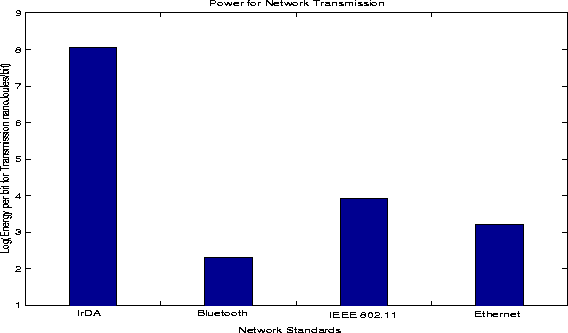
Because network communication is expected to be an integral component of C0PE, a natural standard for analysis is the network. If encryption can keep up with the network, use much less power, much less chip space and cost much less than the network interfaces, then encrypting everything will be feasible. A typical analysis would be of the form, ``Can all devices on a IrDA network sustain encryption at that bandwidth i.e at 115 Kbps ? or ``Can all devices on a Bluetooth network consume less power for encryption as compared to the power required for transmission ?
In a typical mobile environment like C0PE, wireless network standards
such as IrDA, IEEE 802.11 and Bluetooth are likely
to be employed. In this network analysis for encryption, we consider
these standards and also the Ethernet.
Bandwidth.
As mentioned earlier, if the throughput of encryption is greater than the network bandwidth for all devices and environments, universal encryption may be possible subject to other conditions.
In this analysis, we executed an optimized Twofish implementation on the each of the following machines with the corresponding specifications:
We implemented Twofish for a PalmPilot and for the Motorola 6805, values were obtained from experiments done at Counterpane Labs.
The network bandwidths (maximum possible) of the standards considered:
The maximum possible encryption throughput values were obtained assuming full CPU/memory resource availability.
Latency.
Since latency overheads affect the feasibility of universal
encryption, studies comparing latencies of encryption and network
transmission were done on certain applications (refer Section 3.2.2).
Power Analysis.
As previously mentioned, power is an important factor affecting the use of encryption on small portable devices. We analyzed the power consumption of the Twofish algorithm on the following machines with the corresponding power ratings:
Using the results obtained in the analysis for network bandwidth, a maximum
sustainable rate on a particular device,
 ,
was obtained. Let
the power rating of the device be
,
was obtained. Let
the power rating of the device be
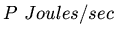 .
Then, the energy per bit
consumed (assuming the CPU works uniformly throughout on encryption) is
.
Then, the energy per bit
consumed (assuming the CPU works uniformly throughout on encryption) is
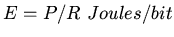 .
The network transmission energy per bit was obtained
as follows:
Let the power consumed for transmission on that medium be
.
The network transmission energy per bit was obtained
as follows:
Let the power consumed for transmission on that medium be
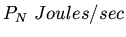 ,
assuming transmission at the maximum possible bandwidth. Let the maximum
bandwidth possible be
,
assuming transmission at the maximum possible bandwidth. Let the maximum
bandwidth possible be
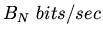 .
Then, the energy consumed per bit
for network transmission is
.
Then, the energy consumed per bit
for network transmission is
 .
.
If E is considerably lesser than EN, i.e if  for all devices,
then universal encryption is feasible on this count (consideration of
power). This means that if ,
encryption is a minimal overhead
in terms of power when compared to network transmission.
for all devices,
then universal encryption is feasible on this count (consideration of
power). This means that if ,
encryption is a minimal overhead
in terms of power when compared to network transmission.