


It is unlikely that all devices may be able to support encryption (as corroborated by our experiments). Also not all applications may demand encryption of data transmitted over the network. Hence, we hereby address the concerns of application developers, considering some specific applications.
In general, performance of the encryption algorithm is more critical in real-time applications. We divide real-time (RT) applications into the following classes:
We consider each of these classes in turn.
Soft Real-Time Applications with Constant Bit Rates (CBR).
A most typical example that falls in this category of applications is
that of audio transmitted over the network. Audio data is typically
required to be streaming into the audio mixer at the host device at a
constant rate of say
 .
Usually,
.
Usually,
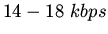 is
sufficient for high-quality audio playout. We also considered the
case of PCM (Pulse Coded Mixer) audio, for which
is
sufficient for high-quality audio playout. We also considered the
case of PCM (Pulse Coded Mixer) audio, for which
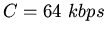 .
.
The analysis for applications in this class is simple: If C is less
than R, the maximum sustainable rate of encryption at that device,
by a significant amount, then audio data can be always
encrypted.
Soft Real-Time Applications with Varying Bit Rates (VBR).
Sometimes, it is difficult to predict the exact rate of data used by
the application. A typical example is the case of video data being
received over a network in a distributed real-time application. In
such case, it is not unusual to employ a buffer to ensure continuous
playout of video. We consider some MPEG video traces as
representative of applications in this category.
MPEG Video Analysis.
We used CODEC [Codec], a MPEG-2 video decoder for our
analysis. We used the traces of a few MPEG videos with
characteristics as given below
| Name | Length (Secs) | Size (MB) | Rate (Frames/Sec) |
| PSYCHO | 53.97 | 9.36 | 30 |
| WALL | 25.1 | 3.58 | 30 |
| HIGHLANDER | 17.13 | 3.22 | 30 |
We then analyzed the time taken for decoding versus the time taken to decrypt the same video trace on each device. We first computed the time taken to decode the entire video trace (assuming the CPU is devoted entirely to decoding), TD. We then computed the time taken to decrypt the encrypted video trace (assuming the CPU is devoted entirely to decryption), TE.
If decryption employs only a minor fraction of the resources employed by
decoding i.e if
 for all devices, then we can conclude that video
data transmitted over the network in a personal environment can always be encrypted.
for all devices, then we can conclude that video
data transmitted over the network in a personal environment can always be encrypted.
The devices considered for the MPEG Video Analysis are the UltraSparc IIi,
Pentium-Pro and the Pentium III machines. A PalmPilot was found to
simply not accommodate the kind of bandwidth that a MPEG video demands.
Hard Real-Time Applications.
In applications belonging to this category, the main concern is that of
the latency of operations. A typical example would be the retrieval
of stock quotes in real-time from a web server.
Real-Time Stock Quotes Retrieval.
Let the size of the data transmitted in one instance of retrieval (the
analysis remains the same irrespective of whether the data is
streaming or not) be D. D could also denote a typical packet
size. Let the network latency viz. the time taken for transmission
and routing etc be TN. Let the sum of the time taken for encryption at the
server together with the time taken for decryption at the host, i.e,
the total time of encryption, be TE. If
 ,
then
encryption does not affect the real-time performance of the
application.
,
then
encryption does not affect the real-time performance of the
application.
The network latency was computed for 3 cases:
In our experiments, we used a fixed data size,
 .
For
the local intranet, TN was found using Berkeley sockets and for the
internet, the UNIX utility ping was used. An approximate value
for TE was obtained assuming that the server is only as powerful as
the host.
.
For
the local intranet, TN was found using Berkeley sockets and for the
internet, the UNIX utility ping was used. An approximate value
for TE was obtained assuming that the server is only as powerful as
the host.