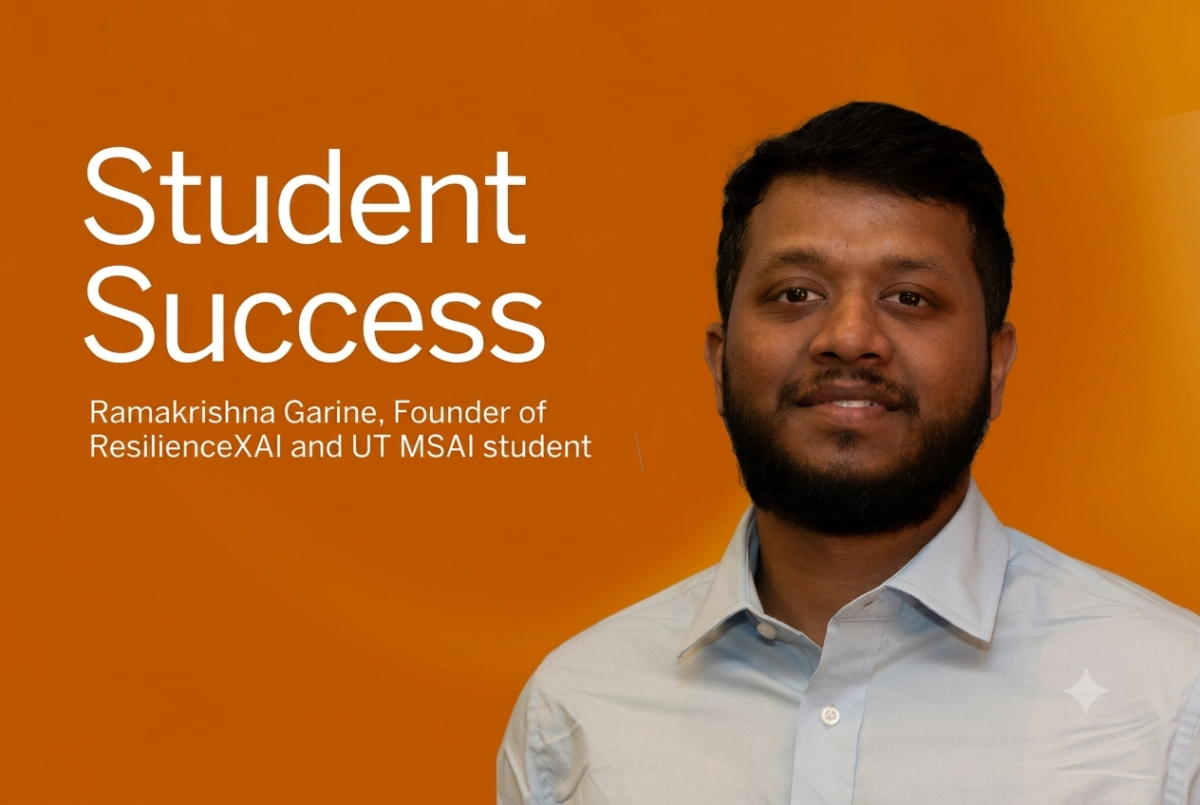
When Ramakrishna Garine sat through executive meetings, waiting days or sometimes weeks for scenario analyses to arrive from data teams, he kept coming back to the same question: why can't this be faster?
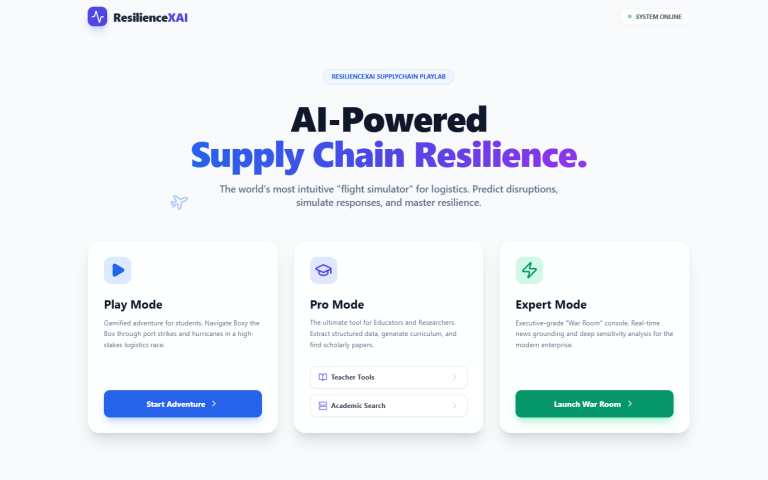
That question eventually became ResilienceXAI, an open-source AI simulation platform designed to help organizations anticipate and respond to supply chain disruptions. Garine built the tool while studying at Computer and Data Science Online’s Master of Science in Artificial Intelligence (MSAI) program, demonstrating how this flexible online master’s program helps students build new technical skills, explore ambitious ideas, and create real-world tools that solve industry challenges.
Today, ResilienceXAI has earned him invitations to guest lecture at universities around the world and speak at international industry events, including the SAP Roadshow hosted by the German American Chamber of Commerce Midwest.
A Search for What Comes Next
Before enrolling in the MSAI, Garine spent more than a decade in supply chain analytics and operations across the retail and automotive industries. As AI began transforming the business landscape, he wanted to deepen his understanding of the field and build the technical foundation needed to adapt, lead, and contribute in an increasingly AI-driven economy.
Garine began to research AI programs, comparing options from universities around the world. Like many prospective students, he was looking for a program that offered both academic rigor and the flexibility required to continue working full time. UT Austin quickly rose to the top of the list.
“It's remote, it's not pricey, and it gives you the flexibility to take one course per semester,” he said. "For people who are working and also thinking about finances, that's really encouraging."
The MSAI degree consists of ten courses, or 30 credit hours, and is priced at approximately $10,000 plus fees. Semester-length courses are delivered asynchronously, with lectures available on demand and assignments released on an instructor-set schedule. Students can complete coursework from anywhere while balancing careers, family commitments, and other responsibilities. For Garine, that combination of flexibility, affordability, and access to a world-class institution made the decision easy.
"When I compared it to similar programs, I found I could get access to the same level of material and faculty expertise at UT for a fraction of the cost," he said.
Learning by Building
One aspect of the program that immediately appealed to Garine was the breadth and flexibility of the curriculum. Ethics in AI is the program’s only required course; beyond that, students may choose electives in any sequence that fits their interests and goals, exploring topics such as machine learning, deep learning, and reinforcement learning.
Garine found the AI in Healthcare course particularly impactful. Across areas such as healthcare data systems, medical imaging, and drug discovery, the course challenges students to look beyond the technical foundations of AI and explore how these tools can be applied to address complex, real-world challenges in healthcare.
For his project, Garine developed a predictive model for polycystic ovary syndrome, a condition that had impacted a family member and made the work personal. The project required far more effort than a typical course assignment, but the results exceeded his expectations. His model ultimately outperformed several existing published approaches.
"The course was challenging enough that it brought out a certain strength in me," he said.
More importantly, the project gave him a repeatable framework for approaching difficult problems. He learned how to combine domain expertise, machine learning techniques, experimentation, and evaluation into a process that could be applied far beyond healthcare. That same methodology later became the foundation for ResilienceXAI.
The Projects That Stay with You
As he progressed through the program, Garine found that the most valuable lessons came from projects that pushed him outside his comfort zone. The Deep Learning and Advanced Deep Learning courses introduced techniques driving modern AI systems, including neural networks, Large Language Models (LLMs), optimization methods, and advanced approaches to model development and deployment.
For Garine, these concepts quickly moved from coursework into practical application. Techniques such as LoRA and QLoRA, which allow LLMs to be fine-tuned more efficiently, are now incorporated directly into components of ResilienceXAI. The projects required persistence, experimentation, and plenty of troubleshooting, but they also provided an opportunity to work with technologies that are actively shaping the future of AI.
"Those projects were not easy," he said. "But they were interesting because you're solving a real problem. I used to wake up at 2 a.m. just to check if the code was still running."
That balance between academic rigor and practical relevance became one of the defining features of his experience. Rather than viewing assignments as isolated exercises designed to earn a grade, he treated them as opportunities to build skills and ideas that could eventually become part of something larger.
A Technical Background Helps, but You Don't Need to Be an AI Expert to Start
One of the most common concerns Garine hears from prospective students is whether they need extensive AI experience before applying. His own experience suggests otherwise.
When he entered the program, he was comfortable writing Python code and working with data, but he was not building machine learning systems from scratch. Most of his technical experience was rooted in analytics and automation rather than artificial intelligence.
"I wasn't a software developer," he said. "I could write Python scripts, but I wasn't building sophisticated AI systems."
What made the difference was not that Garine entered the program with deep AI-specific expertise. It was his curiosity, persistence, and willingness to learn through each course and assignment. The curriculum is designed to support that kind of growth, giving students room to build fluency in core AI concepts, while also exploring specialized areas and advanced applications. Along the way, students gain exposure to both the theoretical principles and the practical techniques that underpin modern artificial intelligence.
Learning From the People Shaping the Field
For Garine, one of the program's most valuable and often overlooked benefits is access to faculty. The MSAI curriculum is delivered primarily by tenured faculty from UT Austin's world-class Department of Computer Science, giving students the opportunity to learn from researchers who are actively contributing to advances in artificial intelligence and machine learning.
The online format allows students to participate from virtually anywhere in the world, while the academic expectations remain those of a leading research university. For Garine, that combination of accessibility and academic quality creates opportunities that are difficult to replicate elsewhere.
"Unless you're part of a program at a school like UT, it's difficult to have those kinds of conversations with experts who are genuinely shaping the future of AI," he said.
His advice for new students is simple: engage as much as possible. Ask questions, attend office hours, challenge assumptions, and bring real-world problems into class discussions. He credits many of his biggest breakthroughs not to a single lecture or assignment, but to the conversations that followed, where faculty and teaching assistants helped him refine ideas and think more deeply about potential solutions.
Building What's Next
Now halfway through the MSAI program, Garine is already planning the next generation of ResilienceXAI. His current focus is on small language models and agentic AI systems. Rather than relying exclusively on large, general-purpose models, he is exploring ways to use smaller, specialized models that can perform specific tasks efficiently and integrate more seamlessly into operational environments.
"I'm trying to think ahead," he said. "For a lot of use cases, you don't need a huge language model. Smaller, specialized models can be more efficient and easier to deploy. That's where I see a lot of opportunities."
His story offers a useful perspective for anyone considering the MSAI program. The degree does not prescribe a single path to success. Instead, it provides a framework for learning, access to deep expertise, and opportunities to apply new knowledge to meaningful challenges. For students willing to invest the effort, those elements can become the foundation for something much larger.
For Garine, that foundation became ResilienceXAI. For future students, it may become the starting point for work they have not yet imagined.
The UT Austin MSAI program is currently accepting applications. Applications for the Spring semester opened June 1, the priority deadline is August 1, and the final deadline is September 1. Details and course information are available at the UT Austin MSAI website.