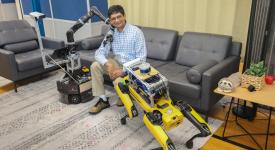
10/07/2026 - Roberto Martín-Martín, Assistant Professor of Computer Science at UT Austin, has been awarded the prestigious 2026 IEEE/RSJ International Conference on Intelligent Robots and Systems (IROS) Toshio Fukuda Young Professional Award.Read More
09/24/2026 - Professor David Zuckerman, Regents Chair in Computer Science at UT Austin, was awarded a fellowship at the Institute for Advanced Study (IAS) in the School of Mathematics for the 2026–27 academic year. This prestigious membership allows for focused research and the free and open exchange of ideas among an international community of scholars at one of the foremost centers for intellectual inquiry. Read More
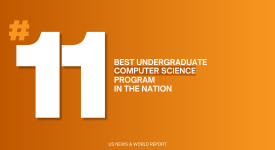
09/22/2026 - The Department of Computer Science at The University of Texas at Austin ranks No. 11 nationally among undergraduate programs in the 2027 U.S. News & World Report Best Colleges rankings, released today.Several undergraduate specialties also placed among the nation’s leading programs. Artificial Intelligence ranks No. 10, Computer Systems No. 11, Programming Languages No. 12 and Cybersecurity No. 13.Read More
09/08/2026 - Every time we buy groceries, we feel the weight of agricultural challenges, from volatile food prices to labor shortages and weather events that strain supply. What if the key to more affordable, sustainable food production wasn't just better farming, but smarter, more accessible robotics? Read More
09/01/2026 - Robots excel in a factory where every movement is programmed in an unchanging environment. But put those same robots in a typical home and they stumble. Homes are messy and unstructured: furniture moves, new items appear every day and the tasks required to navigate a dynamic environment change constantly.Read More
08/27/2026 - UT computer scientist Joydeep Biswas will lead the new NSF Center for Human and Robot Co-Adaptation. The center will unite researchers from six universities to study how robots and people can learn from and adapt to one another.Read Article
08/20/2026 - When incoming Longhorn freshmen sit down this summer to register for their first college courses, there’s a tool they’ll almost certainly be told to download: Read More
08/12/2026 - The U.S. Department of Energy (DOE) recently launched its landmark $293M Genesis Mission—a national initiative that will combine artificial intelligence, supercomputing, and scientific instrumentation into the world’s most powerful integrated research discovery platform.Read More
08/03/2026 - Dr. Peter Stone interviewed by the Associated Press for a story on rising student demand for AI courses that span majors and disciplines. Dr. Stone emphasized the need for AI literacy and broad access to it. AP highlighted UT’s Essentials of AI for Life and Society course, open to all students across disciplines. Read Article