Longhorn Developers undergrads keep UT Registration Plus thriving for tens of thousands of users

When incoming Longhorn freshmen sit down this summer to register for their first college courses, there’s a tool they’ll almost certainly be told to download: UT Registration Plus. The Chrome extension — which lets students build multiple schedule scenarios, see grade distributions, view past syllabi and track real-time course availability — has become so woven into campus life that orientation staff now recommend it as a matter of course.
What many new students won’t know is that the people maintaining and improving the tool are UT students, just like them. Derek Chen, a 2026 computer science graduate, joined the project in his freshman year and worked his way up to technical lead. By senior year, he was the person responsible for the code quality, architecture and feature roadmap of a tool relied upon by more than 60,000 Longhorn students every registration season.
“It’s basically an irreplaceable part of the student experience now,” Chen says. “They tell everyone during orientation to use it. When my sister, who just finished her freshman year, was in orientation, she was like, ‘Oh my god, they’re telling us to use your tool!’”
Building Like a Real Engineering Team
One of the less obvious things Longhorn Developers offers members is experience with software engineering practices that closely mirror professional industry standards. The team runs a rigorous code review process. Every change, no matter how small, goes through multiple rounds of feedback before it ships.
“Even for the smallest thing to get put in, so many people review the code,” Chen says. “Sometimes, one color change would take 200 different discussions, because we wanted to be sure it matched the perfect style.”
The stakes feel real, because they are real. Registration Plus has a hard deadline tied to UT’s registration windows, and any bug that slips through could affect tens of thousands of students at once.
“Our hard deadlines are always a week or so before registration. If anything goes wrong, you can’t have it happen during registration or else 60,000 students will be impacted, and that’s not a good look,” Chen says.
The experience has become one of Chen’s strongest assets in job interviews. He recently secured a software engineering position after graduating, and he credits Longhorn Developers with giving him the depth of experience that made the difference in technical interviews.
“Recruiters really like seeing projects that have such a huge quantifiable impact,” he says. “You’re not just making some quick AI-coded project to show off; it’s a fully from-scratch developed thing. And because it’s collaborative, I have all this experience I can talk about.”
He adds that the personal connections go further than he expected: “Sometimes I’ll actually run into interviewers or technical recruiters who were originally UT students that had used the extension. There’s like a direct personal connection you can make, ‘Oh, I actually worked on that.’”
What’s New in Version 2.4
The team shipped a major update to Registration Plus earlier this year, just before spring registration opened. Among the most-requested new features:
- Course Status Indicators. Students can now see at a glance whether a course is open, closed, or waitlisted directly from the extension. Given that underclassmen frequently have courses close before they can register, this makes planning significantly easier.
- Quick Add. Students can type a course’s unique five-digit number directly into the extension to add it to their schedule instantly, without searching through the course catalog.
- Schedule Export. Users can now export their schedules in multiple formats — including JSON, plain text, PNG, and calendar file formats. The PNG export has developed a life of its own on UT’s Reddit and social media communities, where students share their schedules for peer feedback.
- Dynamic Calendar Expansion. The calendar now automatically expands to accommodate unusually early or late classes — such as 6 a.m. nursing clinicals or late-evening labs — without forcing the view change on students who don’t need those time slots.
The team also significantly improved the extension’s behavior on the official UT course schedule page, adding inline buttons for grade distributions, syllabi, and professor reviews, and enabling infinite scrolling to replace the clunky page-by-page navigation the site previously required.
Beyond Registration Plus
Since formalizing as a student organization, Longhorn Developers has grown to a Discord community of roughly 900 members and expanded well beyond its flagship project. The organization now works officially with UT’s Enterprise Technology team, meeting regularly to present progress on student-built tools and receive feedback and support.
Projects currently in development include:
- Longhorn Loop. An app designed to help students find community through a personalized event board while easing the stress of club recruitment. Students are shown events curated to their profiles, while organizers can track analytics about people who RSVP to their events. The team is moving into beta testing this week. More information is available in Longhorn Developers’ latest Instagram post.
- UT Lectures Plus. A Canvas enhancement that adds transcriptions and navigation tools to recorded lectures, making it easier to search and review course content before exams.
- Degree Audit Plus. An expansion of UT’s existing degree audit system, designed to make it easier for students to map out their remaining requirements and plan future semesters alongside their Registration Plus schedule.
- Longhorn Lifts. A logistics platform for Sure Walk, UT’s late-night safe ride program, which currently relies on manual coordination. The team hopes to partner with UT’s parking and transportation service to bring the app into official use.
"These are things that will actually be put out and help a lot of people,” Chen says. “We look for students that care about the student body and want to make solutions, because we have the support, we have the users and we have UT officially sponsoring us.”
A Community, Not Just a Resume Line
Chen is quick to point out that Longhorn Developers isn’t just a place to accumulate professional credentials. The organization runs socials, from a rooftop kickoff at the start of the year to recent outings to a downtown arcade. The friendships formed through long coding sessions became some of the most meaningful of his time at UT.
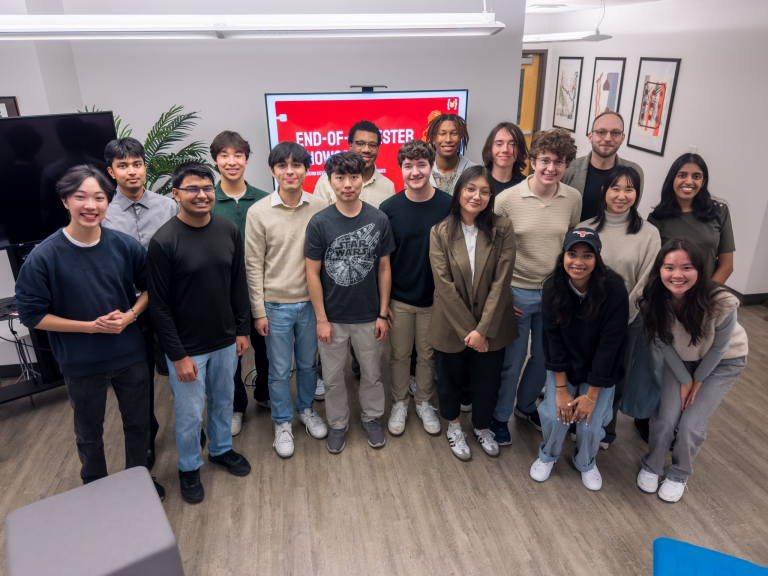
Longhorn Developers is also more than a software organization. As the organization has grown, so has the range of skills needed to build its products. Product management and UI/UX design now make up a large part of its work, with students contributing across user research, prototyping, development, and iteration. The organization has opened its doors beyond computer science majors, welcoming designers, product managers and students from other disciplines. “People make a lot of friends in their teams because of how diverse the org is now,” Chen says. “Not just CS majors, but anyone who’s passionate can join.”
UT Registration Plus is available as a free Chrome extension. To learn more about Longhorn Developers, fill out their interest form or look for them on Discord. See here for a list of other undergraduate student organizations at CS.