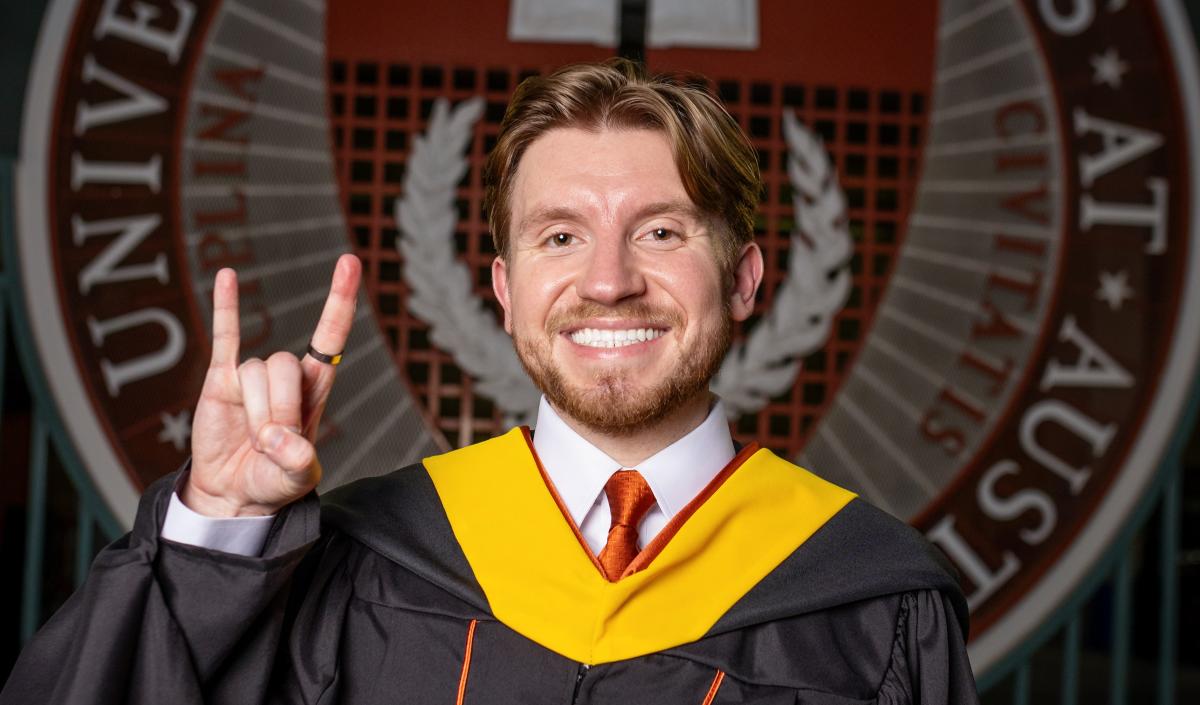
Carter Leslie is a software engineer at USAA who enrolled in UT Austin's online Master of Science in Artificial Intelligence program in fall 2024. A double CS and math major from Abilene Christian University, he was drawn to AI for sitting squarely at the intersection of both disciplines. Now on the verge of completing the degree in five semesters while working full-time, he sat down to reflect on the experience.
Who or what surprised you most about being part of UT Computer Science (UTCS), and what would you tell your first-day self?
The workload was more than I expected, though not for the reasons you might think. The material itself wasn't overwhelming. It was more that I hadn't fully factored in the mental bandwidth of doing it alongside a full-time job. I figured eight hours of grad school would be manageable, even with harder material. But there's a difference between knowing that intellectually and actually living it across five semesters.
The asynchronous format was also an adjustment. I've always learned well in person, and I was never afraid to ask questions during a lecture. With online coursework, you have to find other ways to stay connected. What really helped me was the student community. We have Discord servers where students talk in real time, and being active in those made a huge difference. Someone could say, "Oh yeah, I was stuck on that too, try thinking about it this way," and suddenly you're moving again.
My biggest piece of advice to a first-day version of myself: take it slow. The async format means no one is walking you through it, which is actually something you have to learn to appreciate. I pushed myself to finish in five semesters while working full-time, and I'm proud of that, but I think I would have gotten more out of some of the material if I'd given myself more time to go deeper. That's the one thing I'd go back and change.
What's something you were able to do at UTCS that you don't think you could have done anywhere else?
The deep learning classes, Deep Learning and Advanced Deep Learning, are genuinely great. The projects, especially the third and fourth ones, are incredibly valuable. One of the most important things to understand in AI right now is transformers, and both courses dig into that seriously.
What made those projects so effective was that they forced real understanding. The dataset changed slightly each time, so you couldn't just recycle what worked before. You had to dig in, tune hyperparameters, and think about your architecture.
The final project from Advanced Deep Learning really stuck with me. You had to process an image and produce something a human could understand, describing the position of objects relative to each other. On the surface it looked like a vision problem, but the solution wasn't vision-only. That taught me something the project wasn't even really designed to teach: the metric you use to evaluate a model matters. My model outputted "behind" when it was supposed to say "back," and the grader marked it wrong. Looking at it in a vacuum, that's not really wrong, but the evaluator said otherwise. That's a really important thing to understand about AI in practice.
I actually saved all the starter files before I modified them, because I want to go back and redo those projects after I graduate, with the AI coding assist turned off, just to prove to myself I can work through them without help. The rabbit hole really does go that deep.
Where are you headed next, and how did UTCS specifically prepare you to get there?
I'm hoping to move into an AI and machine learning role, whether that's at USAA or elsewhere. And I feel genuinely confident going after those opportunities because of this program.
What the degree gives you is something really specific and valuable: you come out knowing many of the best techniques and methods for solving different kinds of problems. You won't know every solution to every scenario, because nobody does. But you'll know how to approach a problem, what tools are available, and how to start adapting those tools to something new.
The other thing I've come to appreciate is that you get out of it whatever you put in. I used to resist that idea. I felt like everyone should come out of a degree having learned the same things. But it's not that simple. You can do perfectly good work that meets expectations, or you can dig deeper into the same assignment and get significantly more out of it for the same grade. The program creates a controlled environment where you can genuinely test the limits of what you can learn and do. That's not something you can replicate on your own.
Even if someone goes in just for the credential, that alone is well worth the time investment, given what doors it opens. But the real value is that the program gives you everything you need to keep going after you graduate. I'd do things differently pace-wise if I had the chance to do it again, but there's no doubt in my mind I'd always make the decision to join the program.
Interested in UT Austin's Online MSAI? Click here to learn more about the program, curriculum, and admissions.