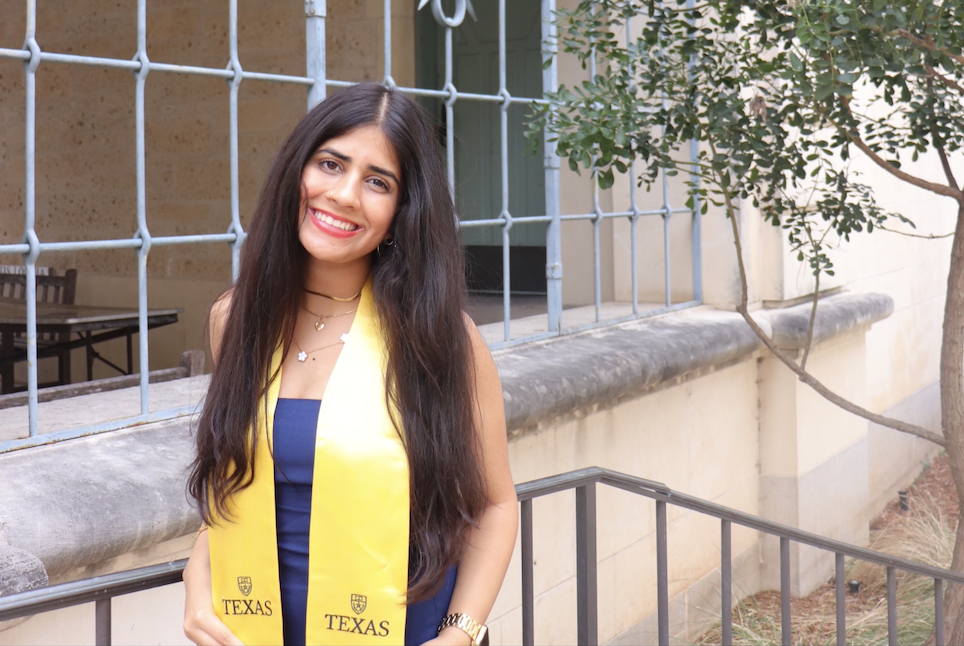
Arushi Sharma is a computer science and math double major at UT Austin. After interning at Amazon the summer before her senior year, she secured a return offer as a software engineer at their Seattle headquarters. She sat down to talk about what surprised her at UT Computer Science (UTCS), what sets the program apart, and what she'd tell anyone hoping to follow a similar path.
Who or what surprised you most about being part of UTCS, and what would you tell your first-day self?
What I would tell my first-day self is that it's totally okay to not have it all figured out, even if you're surrounded by great people at a great program. It's a top 10 program in the country, so coming in, I felt like everyone around me knew exactly where they were going and had it all planned out. I felt like that was what I needed to be too. But the reality is, the people next to me didn't really know what they were doing either, and the whole purpose of college is that you figure it out.
That was genuinely surprising to me, but in a great way. There are so many different opportunities and paths you can explore at UT Austin, and it's really about being open to change and not putting pressure on yourself to have everything figured out from the second you walk in. Even now, I don't have everything planned out for the next phase. I set small benchmarks for myself, a six-month goal, a twelve-month goal, and that really helps. Nobody could have predicted where AI would be today, and tools such as ChatGPT didn't even exist when I committed to UT. Things are always shifting.
Another thing is, go to office hours for your classes. It took me some time to start going, but they made a noticeable difference in how I learned. And get a Notion calendar, or something like it. In high school you have a 9-to-5 structure built in. College gives you freedom, but your classes are a lot harder, and you have to be intentional about carving out time for studying, assignments, and yes, a social life too. Time management was honestly one of the biggest things I learned here.
What's something you were able to do at UTCS that you don't think you could have done anywhere else?
What stands out most is how seamlessly UTCS lets you explore different things and actually go deep into them, all at the same time. In class, I've been able to work on real-world projects. Last semester I took geospatial AI and we worked on wildfire prevention using AI. That kind of applied coursework is something I don't think you get everywhere.
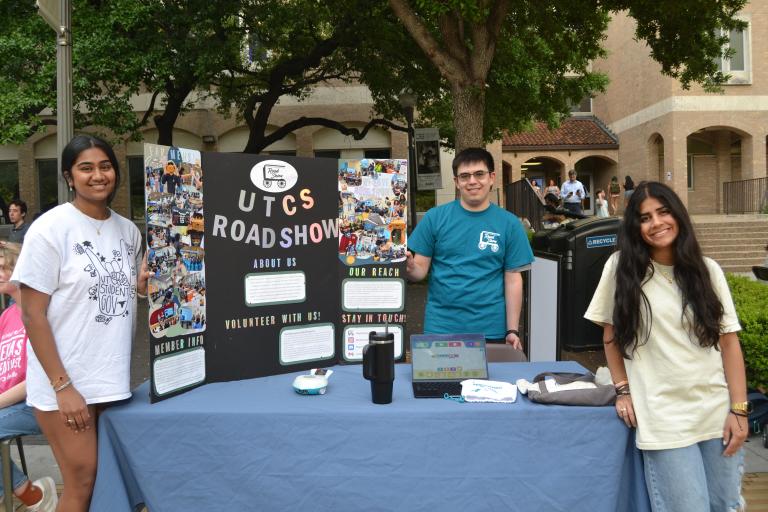
Outside of class, I've been an officer for CS Roadshow, where we go to elementary schools, middle schools, and high schools around Austin and teach kids about CS, whether that's introducing them to the field or getting them hands-on with robots. I've also been a TA for one of the CS certificate classes, which gave me a completely different perspective, helping students who aren't CS majors learn programming and data structures. And for my first three years I was doing research with a lab on campus. I got to present my research to faculty at UT Research Week.
None of those things felt like separate tracks. UTCS made it easy to integrate all of it into one experience and grow not just as a computer scientist, but professionally and personally. Some of my classes even pointed me toward research opportunities and encouraged me to take what we were doing in the classroom further. I really don't think I could have combined all of those things in the same way anywhere else.
Where are you headed next, and how did UTCS specifically prepare you to get there?
I'm heading to Amazon in Seattle as a software engineer. I interned there last summer and got my return offer, so I'm really excited for that next step.
In terms of how to get there, I don't think there's one set formula, but UTCS gave me two things that I think made the biggest difference. The first is the technical foundation. The coursework genuinely prepares you for the kinds of problems you'll face in interviews, and I've been able to apply the AI skills I've been building in class directly in my internships.
The second is learning how to use the resources around you. I remember going to my first CNS career fair and completely fumbling my elevator pitch. But I learned from it, and I kept showing up. The Friends of Computer Science recruiting events, the resume reviews, the workshops – all of that gives you real practice with real recruiters. Even if nothing comes of a conversation immediately, you're building a connection and sharpening how you talk about yourself, and that matters.
My honest advice: technical skills and soft skills are both essential, and neither one covers for the weakness of the other. A strong resume gets you in the room. But once you're in the room, you have to be able to communicate clearly, talk through your thinking, and work with people. UTCS prepares you for both, but you have to take advantage of what's there. The resources exist. The question is whether you use them and how.
Explore the student organizations and community that shaped Arushi's experience at UTCS Community & Organizations.