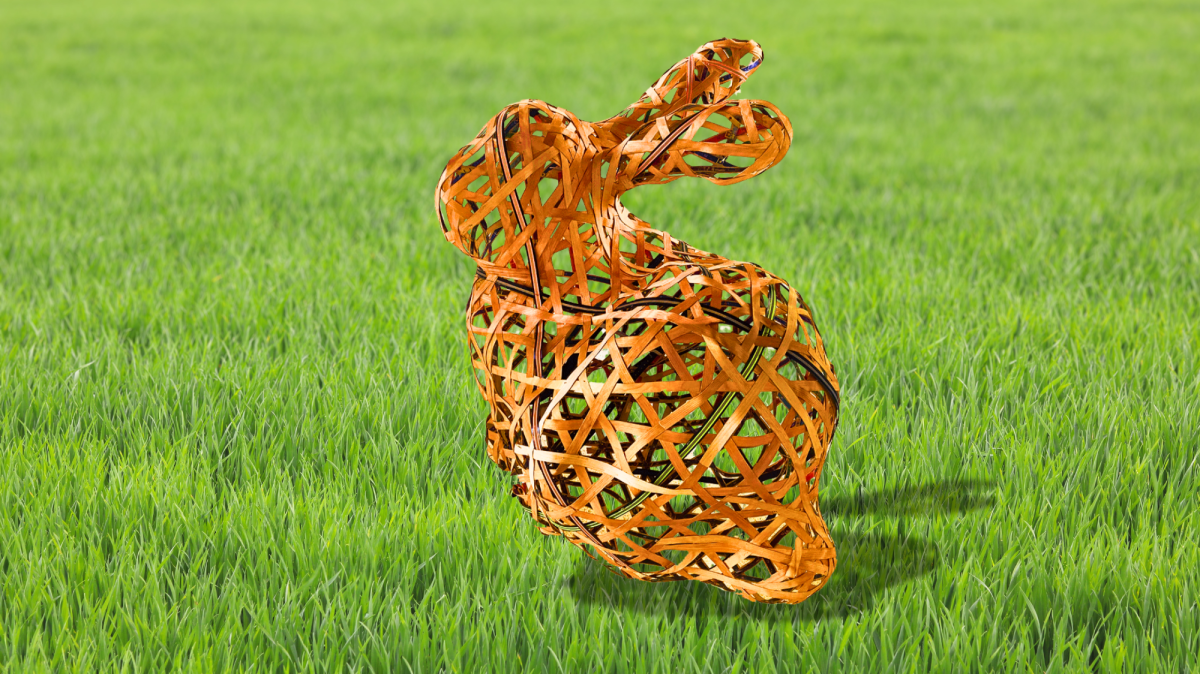
In Brief: A woven bunny sculpture showcases research using algorithms to design complex 3D structures from simple strips of material. Weaving makes objects stronger and lighter, but designing intricate shapes by hand is too complex to scale. This work uses computation to precisely map how each strip should intersect, unlocking repeatable, efficient fabrication. The approach could enable lightweight aerospace parts, custom medical devices, and new manufacturing methods.
The next time you walk into the Computer Science building, watch out for the bunny. Believe it or not, there’s one currently hanging out inside, potentially unnoticed by the hundreds of people who visit the Gates-Dell Complex daily. Be sure to look up.
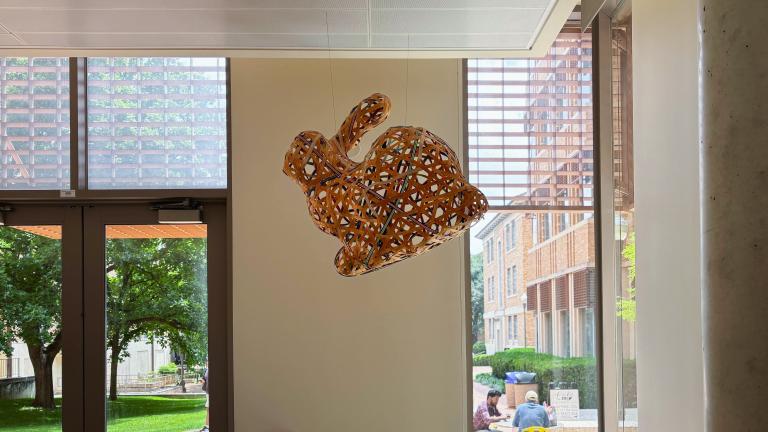
The bunny you’re looking for is not the furry, cute animal you’re imagining. It’s a woven structure made from hundreds of birch veneer strips, built by UTCS PhD student Josh Vekhter as part of his dissertation research. The goal of the project? To develop a computer algorithm for creating a physical structure completely from straight ribbons of material.
Weaving is an ancient craft for a reason; interlocking strips create structures that are stronger and more rigid than any single piece, while remaining lightweight. That combination makes it highly valuable across industries, from aerospace to surgical medicine, where intricate, low-weight designs are critical. The challenge is that for complex 3D shapes, figuring out how each strip should meet and bear load is nearly impossible to do by hand in a consistent, efficient way.
“It’s kind of like a jigsaw puzzle,” Vekhter explained recently. Working with collaborators, he designed a software pipeline for designing woven structures. This process starts with a goal– a specific physical shape– then works backwards to develop the computational inputs that lead to that desired structure. “Where do the strips of a weaving pattern meet one other, and at what angles, in order for them to approximate the target shape that you specified in the computer once they're assembled?”
In this case, that shape was a rabbit—to be precise, a Stanford bunny, a popular model in computer design. But how did a UTCS PhD student end up spending late nights weaving a bunny?
“It was a bit of a whimsical project,” Vekhter explained. After working at a 3D printing company and developing a personal interest in weaving (the result of a now-clearly-auspicious gift of a loom), he came to UT Computer Science to pursue a PhD. He then let his research topic develop through curiosity-driven research—finding a compelling topic within the field of computational fabrication that he was interested in, and exploring it freely, rather than starting the process with a specific end-goal in mind. “We started out doing things that seemed fun and interesting. We couldn’t have anticipated where it led us, and that’s how research goes.”
Etienne Vouga, Vekhter’s advisor and UTCS assistant professor, believes that Vekhter’s approach, while increasingly less common, has great value for other students to emulate– particularly within an academic system where competition for funding can often encourage research topics with guaranteed deliverables or applications. “Especially when we’re doing basic science in fields like computer science, we don’t always know what the applications are going to be of the work that we do,” Vouga noted. “It is really important, even with all these pressures to avoid it, to still try to do this curiosity-driven research as much as possible in areas in the natural sciences, where we're supposed to be doing fundamental research.”
What has become clear, however, is that while Vekhter did not begin his research with a particular deliverable in mind, the exploratory work carried out in this project has consequential and tangible applications in various fields. Design software for weaving could have real-world use for various industries—from creating a woven medical stent custom-made for individual patients, to building complex woven products lightweight enough to be used in aerospace technology.
“We did ultimately make progress on an economically and scientifically valuable problem. And the only reason that we got there was because we started out doing things that seemed fun and interesting,” Vekhter said. After developing a computational fabrication process to design a woven structure, Vekhter also realized his work could help address challenging theoretical questions in advanced volumetric modelling that had vexed researchers for years.
Theoretical contributions were not quite enough, however. In trying to get his weaving research published, Vekhter was told by multiple reviewers that he would need to prove his research could yield physical results. He had to build the bunny.
“It was a lot of work,” he said. “But doing a lot of manual work that doesn’t scale is often part of working on a research project.” And he wasn’t alone. “It was like a village came together to put it together,” he says. This involved recruiting a crossdisciplinary team, including Luisa Gil Fandino from the UT Textiles and Apparel Division, UTCS professor Qixing Huang, Vouga, other UTCS PhD students (including co-author Jiacheng Zhuo), friends, roommates, and even some of Vehkter’s family members. Together, this village printed the bunny’s blueprints—indicating the specific angles at which each wooden strip should be placed in relation to one other—as stickers, which were then transferred onto hundreds of strips of individual wooden ribbons, and used these directions to painstakingly assemble the structure from scratch.
The result is currently hanging near the eastern entrance of the Gates-Dell Complex. Vekhter felt that because the structure was made in UTCS, that was where it should stay (he also admitted that he has little need for a three-foot tall woven bunny). His hope is that when students walk by the sculpture, it might inspire an interest in computer graphics, or at least provoke students to pause and consider their research goals. Maybe future students, in looking at this bunny, will feel compelled to research for research’s sake, and let their curiosity guide them to explore new and interesting problems, without putting as much stock into the work’s “practical” implications.
“Hopefully this plants the seed of craft… slowing down as a response to the ever-increasing pace of all the technological stuff that we're living through at the moment. Maybe we could just allow ourselves to work on seemingly impractical, really time-consuming things,” he reflected. “If nothing else, we'll at least have more intricate, beautiful things in the world this way.”
So, the next time you walk into the Gates-Dell Complex, stop and keep an eye out for a bunny. The closest one may be above you, waiting for you to consider it.
Learn more about this research project. Weaving Geodesic Foliations.