Research

This is Not a Bunny: The Research Path from Whimsy to Better Spacecraft Fabrication

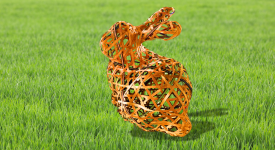
Woven, lattice-like rabbit sculpture made of brown wooden strips, positioned on green grass with a soft, blurred background.

04/16/2026 - In Brief: A woven bunny sculpture showcases research using algorithms to design complex 3D structures from simple strips of material. Weaving makes objects stronger and lighter, but designing intricate shapes by hand is too complex to scale. This work uses computation to precisely map how each strip should intersect, unlocking repeatable, efficient fabrication. The approach could enable lightweight aerospace parts, custom medical devices, and new manufacturing methods.

This AI Agent Might Just Be the Coach You've Always Needed

AI Coach

02/02/2026 - Imagine having a pair of smart glasses that don’t just record what you see, but truly understand it. Maybe you’re DIYing a leaky faucet, improving your tennis swing, or rehabbing a shoulder injury, and there’s an AI expert guiding you with real-time, personalized feedback.

Adaptive Anatomy: 3D Models That Fit Every Form

Adaptive Anatomy

12/17/2025 - Digital modeling is one of the most widely used tools for bringing bodies to life in 3D. Created from thousands of everyday images and videos, 3D generative models employ artificial intelligence to help us understand the structure of animals and humans. These models are essential for a wide range of real-world applications, including biological research and surgical planning. Existing generative models, however, have limitations as they rely on training data that consists of fixed, typical skeletal structures—and nature is anything but typical. 

UT Expands Research on AI Accuracy and Reliability

Photograph of one of the UT Austin Gates Dell Complex towers, shot from below looking upward.

07/29/2025 - Big news from UTCS: With renewed funding from the National Science Foundation, IFML researchers are expanding their work to make AI more accurate, reliable, and ready for the real world. This critical research will strengthen how AI systems function — and accelerate progress in science, technology, and workforce innovation.

Daehyeok Kim Wins National Research Award for Advancing Cloud Hardware Efficiency

A professional portrait of Daehyeok Kim, smiling and wearing glasses and a light-colored blazer. Bold text on the left reads "National Research Award for Advancing Cloud Hardware Efficiency" against a blurred cityscape background. His name appears on the right side in white text.

07/23/2025 - Daehyeok Kim, an assistant professor in the Department of Computer Science at The University of Texas at Austin, has received a 2025 National Science Foundation (NSF) CAREER Award for his project “Toward Programmable NICs as Multi‑Tenant Cloud Resources.” The award provides $622,738 over five years to su

Smarter Land Use Decisions with AI for a Sustainable Future

Aerial image showing different types of land use, including farming, forest and housing.

05/20/2025 - Researchers at The University of Texas at Austin and Cognizant AI Lab have developed an AI-driven system that leverages 175 years of global land use and carbon storage data to generate optimal environmental policy strategies. The AI model, backed by Project Resilience and AI for Good, balances complex trade-offs to maximize carbon storage, minimize economic disruption, and improve everyday life.