Every time we buy groceries, we feel the weight of agricultural challenges, from volatile food prices to labor shortages and weather events that strain supply. What if the key to more affordable, sustainable food production wasn't just better farming, but smarter, more accessible robotics?
Enter FarmBrain, a pioneering research project supported by a National Science Foundation (NSF) VINES award that aims to reduce the cost of deploying and managing agricultural robots with edge computing and wireless networks.
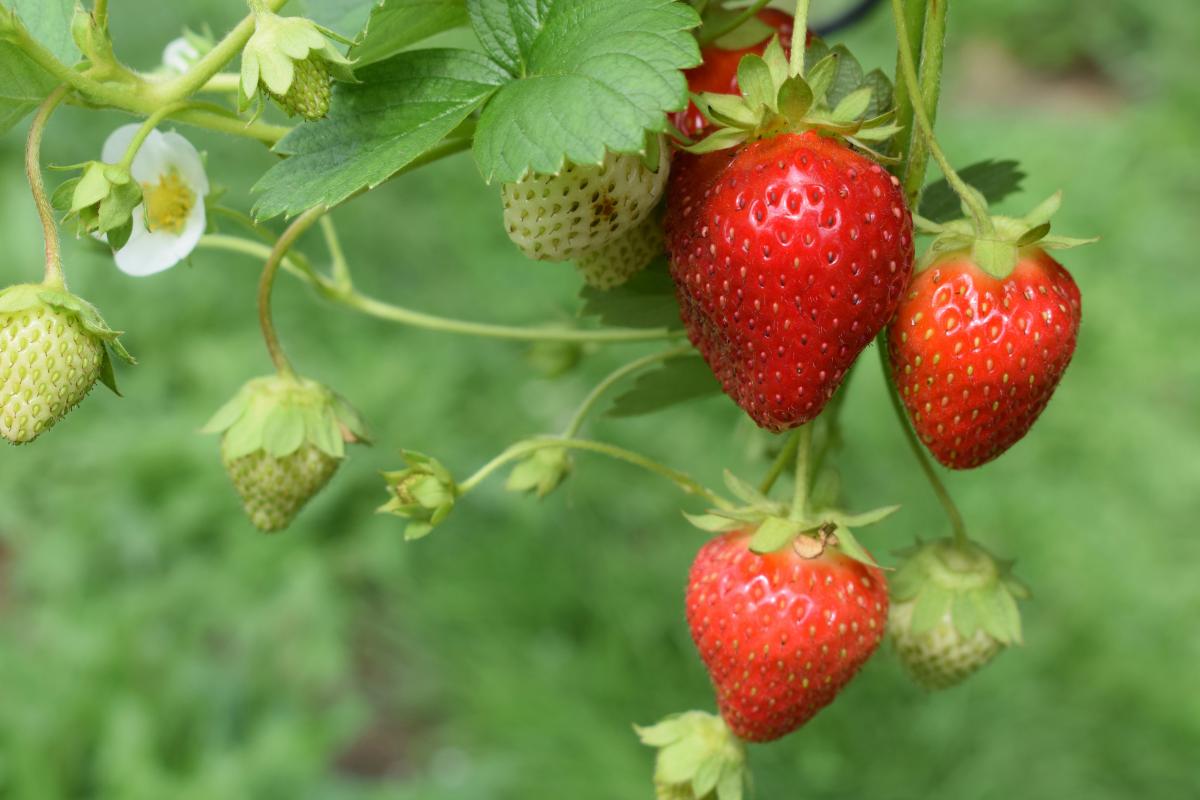
Today, harvesting delicate crops like strawberries remains one of the trickiest tasks to automate. In the field, a robot must navigate an ever-changing environment with shifting sunlight and shadows and adjust its grip in a fraction of a second so it doesn’t crush the bounty.
While artificial intelligence can give robots very sophisticated perception and reasoning skills, these capabilities typically require bulky, power-hungry and extremely expensive supercomputers on every single robot, an option out of reach for most farmers.
FarmBrain reimagines this approach with a team of UT experts: Daehyeok Kim, networks and edge computing, Aditya Akella, systems for machine learning, and Volkan Isler, a core member of Texas Robotics.
Local Reflexes, Shared Intelligence
Rather than placing a costly computer on every unit, FarmBrain splits the computing workload into two layers over a private, farm-wide cellular network. Mission-critical safety routines and immediate physical reactions stay directly on the machine while complex AI operations, such as vision analysis, path planning and crop evaluation are offloaded to a powerful, centralized compute node on the farm.
“Every robot keeps its own reflexes while the fleet shares a nearby brain,” says Daehyeok Kim. “Sharing that resource could make individual robots simpler, lighter and less expensive without giving up the intelligence needed for delicate work.”
FarmBrain relies on an interdisciplinary approach because the robots, the AI, the network and the nearby computer form one connected system. That is why the team's complementary expertise is so important. Kim contributes expertise in cellular networks and edge computing. Akella brings expertise in systems for machine learning and programming. Isler brings extensive experience in robotics, computer vision and agricultural applications.
Together, the research team can ask questions that sit between traditional fields. How should a robotics program be divided between the robot and the edge? How should the network and computer prioritize several robots with different deadlines? How should the system diagnose a problem that may begin in the field, in the wireless link or shared computer? Most importantly, how should the robot respond safely when any of these components fail?
“A better AI model isn’t enough if its answer arrives too late,” says Kim. “A faster wireless network isn’t enough if the robot can’t remain safe during a disconnection. The system must be designed end to end so that the pieces work together under real farm conditions.”
If deployed at scale, this low-cost model makes automated farming accessible to a much broader range of producers, not just the largest operations. For everyday consumers, that could mean a more reliable food supply as farmers contend with labor shortages, rising costs and unpredictable weather. Smarter, more precise equipment could also help growers use water, fertilizer and pesticides only where they are needed, reducing waste, lowering environmental impact and potentially helping keep the cost of producing food, and ultimately grocery prices, more manageable.
From the Lab to the Field and Beyond
While FarmBrain is tailored for agriculture, its architecture applies broadly across industries, applications and intelligent machines that must safely navigate and function in the real world. By proving that teams of light machines can rely on shared nearby compute over private networks, FarmBrain could be applied to manufacturing environments, autonomous vehicles, even multi-agent search and rescue operations.
To accelerate research, the team plans to release FarmBrain’s core stack, programming tools and benchmarking suites as open source so that other researchers and practitioners can adapt the foundation to new industries.
Preparing the Next Generation of Engineers
Beyond technological contributions, FarmBrain serves as an active educational training ground. Building responsible real-world AI requires an understanding of physical safety, network latency, computer systems, human needs and the consequences of system failure.
Ultimately, FarmBrain isn't just solving a complex technical bottleneck in the field; it’s cultivating the tools needed to enhance human-robot collaboration. By uniting systems design, networking and real-world applications, UT Austin researchers are ensuring that the future of precision farming remains smart, sustainable and accessible to all.
Learn more about the UT Networked Systems Group and Texas Robotics.