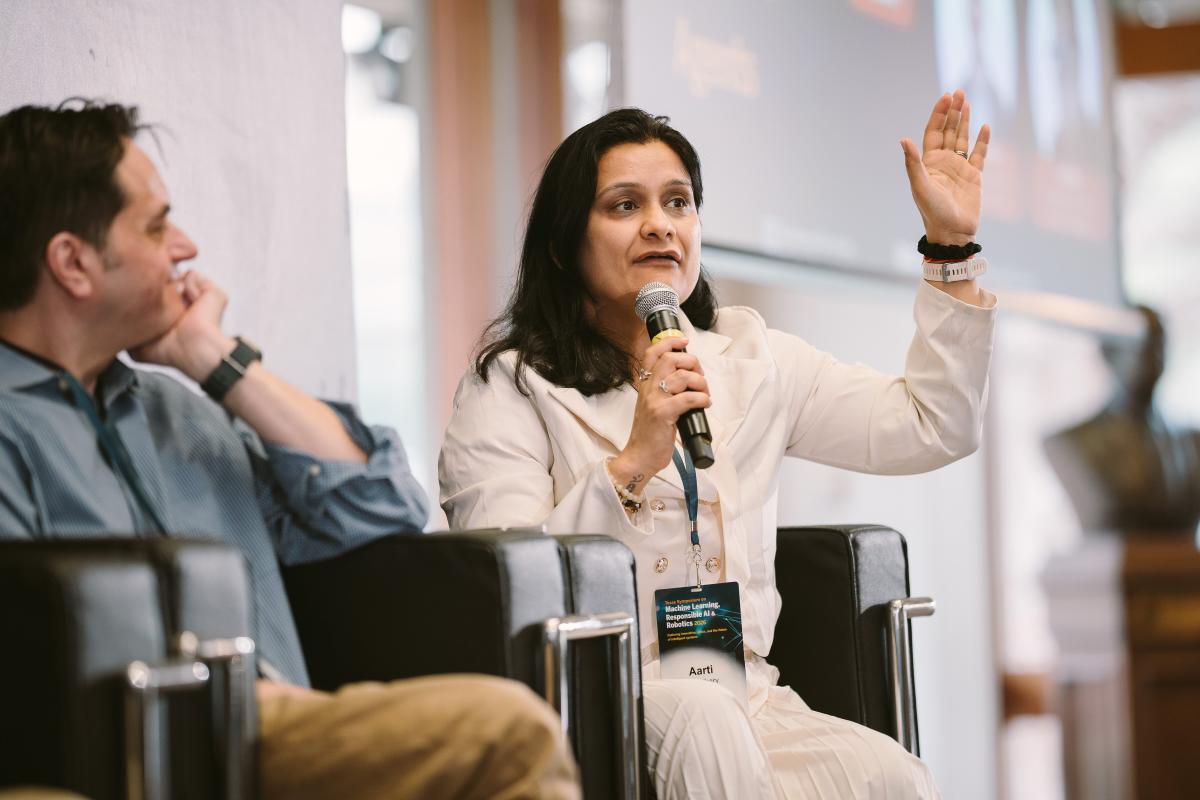
What should be next for AI? That was the question on everyone’s mind at the recent Texas Symposium on Machine Learning, Responsible AI & Robotics, held here on the Forty Acres. This symposium, hosted by Texas Robotics, the Machine Learning Lab, and Good Systems, brought together hundreds of leaders from industry and academia to discuss ongoing research around the intersection of ethics and AI innovation. The industry connections and partnerships formed through symposiums like this are vital in answering critical questions about the future of responsible AI development.
One panel, “Reimaging Work in the Age of AI Agents,” focused on the ongoing rise of agentic AI in the workplace. Right off the bat, people wanted to know: is AI coming for your job? “AI is not going to take your job, but someone who uses AI really well might take your job,” remarked Lucas Meyer, Principal Research Scientist at the Microsoft AI for Good Lab.
Moderated by Luis Sentis, former chair of Good Systems and professor at the Cockrell School of Engineering, the panel brought together varied perspectives from the tech industry, academia, and cybersecurity realm. These panelists addressed the important considerations facing managers, company executives, policymakers, and workers as AI agents become more deeply ingrained in the modern workplace.
“AI is not coming for your job,” said Aarti Choudary, Global Lead for Responsible AI at AMD. “AI is coming for the work you are doing so you are more empowered to do it better.” AI systems have the potential to streamline our productivity and significantly cut the hours we spend on work tasks, eliminating busywork and creating opportunities for more meaningful projects.
Additionally, even for specialized, technical, and manual laborers whose work cannot be done by AI, there is still a role the technology can play in their jobs. “We should look at what percentage of a plumber’s time is spent on plumbing, and then what percentage of their time is spent on everything else: billing, invoices, setting up a website,” said Elias Stengel-Eskin, UT Computer Science assistant professor. All these tasks can now be done with AI. “It might be something that really opens up the door to owner-operator businesses.”
However, to succeed in an evolving workplace, multiple panelists emphasized the need for companies and workers to understand how to use AI systems. “The nature of work is changing. You need that continuous learner’s mindset, and that’s going to be an ongoing lifelong commitment,” said Nancy Morgan, CEO of Ellis Morgan Enterprises. The imperative is not just on companies to train their workers, but also on individuals to reskill themselves to compete in today’s workforce.
A major takeaway from this panel and the larger symposium: AI systems are rapidly changing the world. It’s up to all of us in academia and industry to create guardrails and practices around AI systems, so they can deliver the most benefit, while limiting their potential negative consequences. Symposiums like these, the connections they foster, and pivotal research by Texas AI and UTCS are vital in shaping the future impact of these technologies.
Watch more talks from the symposium.