A decade later, Huang’s collaborative research on helping computers recognize 3D object parts earns recognition for its lasting impact.
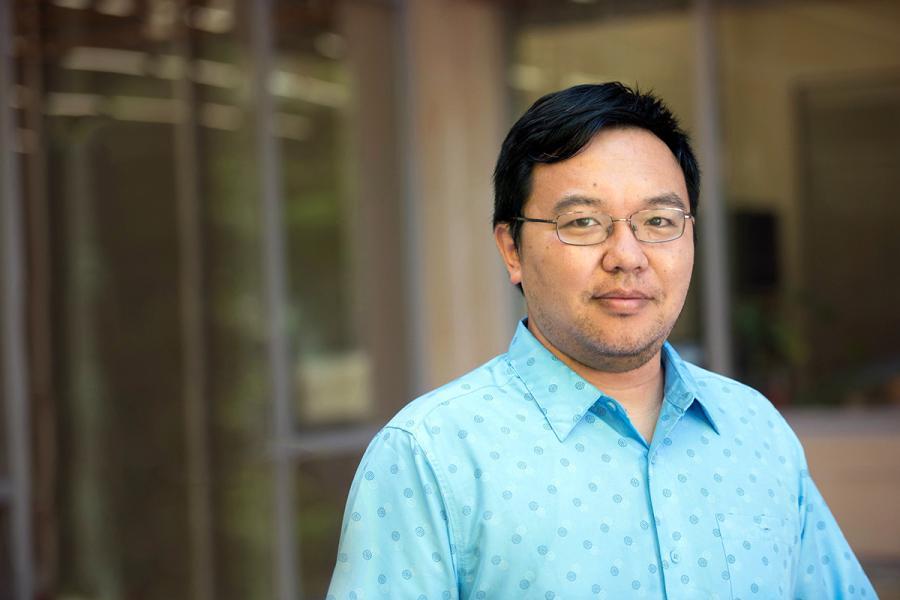
A chair’s seat, an airplane’s wing, a lamp’s shade: people readily recognize these parts, but teaching computers to identify them requires carefully labeled examples. A research paper co-authored by UT Austin computer science faculty member Qixing Huang helped make those examples available at a much larger scale.
Now, a decade after its publication, “A Scalable Active Framework for Region Annotation in 3D Shape Collections” has been selected for the SIGGRAPH Asia 2026 Test-of-Time Award, recognizing its exceptional and lasting impact on computer graphics.
Published at SIGGRAPH Asia 2016, the paper addressed a major challenge: labeling the meaningful parts of thousands of digital 3D objects without requiring people to mark every part by hand.
The team developed a process that combined human annotation, automated labeling and human verification. People labeled selected objects, and the system used similarities between shapes to transfer those labels to others. People then checked the results, providing feedback that improved subsequent predictions.
Human verification was central to the approach. Checking a proposed label could take far less time than creating one, and the system accounted for both tasks when deciding where human effort would be most useful.
The researchers produced more than 93,000 verified part annotations across nearly 32,000 models in 16 object categories. They estimated that the work required 110 hours of human effort, compared with 780 hours for fully manual labeling.
The resulting collection was more than ten times larger than existing segmented 3D datasets. The work created ShapeNetPart, which became a widely used benchmark for teaching computers to recognize object parts.
Bringing together collaborators across five institutions, the project helped build a resource for the broader research community. Ten years later, the award celebrates both the original innovation and its enduring contribution to 3D deep learning.
Explore more achievements and honors from UT Austin’s computer science community.