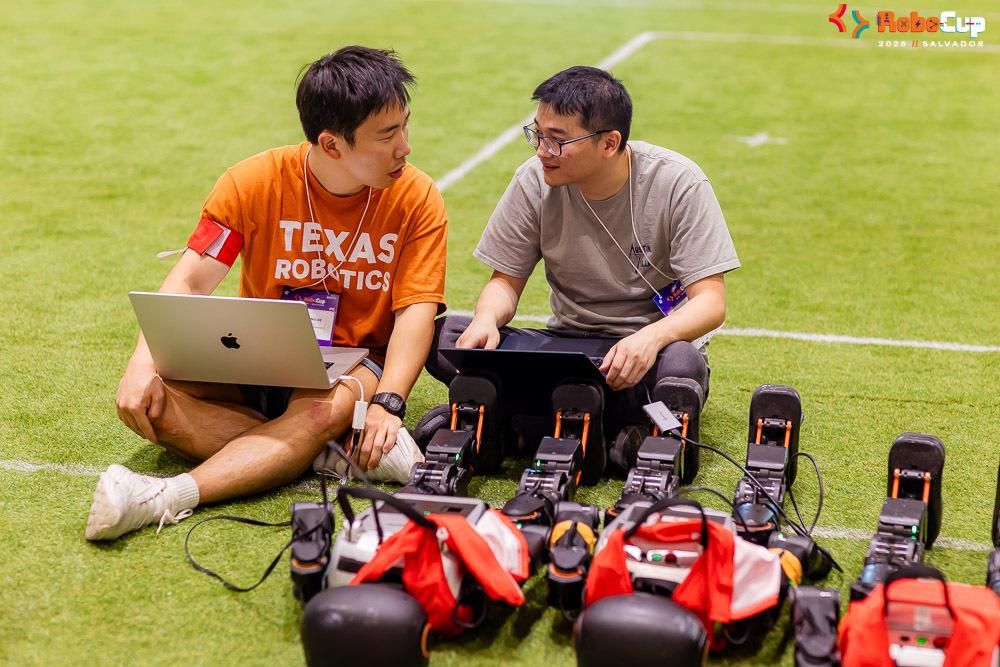
PhD students Dongmyeong Lee and Zifan Xu prepare their child-sized humanoid robots before a match at RoboCup 2025 in Salvador, Brazil.
The soccer field in UT Austin's Gates-Dell Complex is smaller than what you’d see in the FIFA World Cup. The goals are low, the turf a little worn, and the players are less than four feet tall. But don't let the modest setup fool you. What's happening here is university research that sits at the intersection of robotics and artificial intelligence. And year after year, the team proves that smaller, smarter autonomous systems can reach great heights.
UT Austin Villa, the award-winning robot soccer team from Texas Robotics, is packing up its humanoid robots and heading to Incheon, South Korea, to compete in RoboCup 2026. Established in 1997, RoboCup is the brainchild of four researchers who set out to create a humanoid robot soccer league that could defeat the FIFA World Cup champion by the year 2050. That vision has grown into the world’s largest and most prestigious international robotics competition. In a wide range of categories, teams have pushed the boundaries of what robots can accomplish, advancing research in computer vision and perception, localization, and mapping systems. This research translates directly to progress in autonomous driving, the real-world capabilities of space rovers, and applied robotics in hazardous environments.
UT Austin’s robot soccer team has been competing in the games for more than two decades. Led by professors Peter Stone and Joydeep Biswas, the current UT Austin Villa team is made up of three PhD students and three undergraduates. One of those PhD students is Zifan Xu, a fifth-year researcher whose work sits at the heart of what makes these robots remarkable.
“My PhD dissertation is about using reinforcement learning for diverse motor skills,” Xu explained. “For soccer, the rule is simple, just kick the ball into the goal. But with that simple rule, a human can develop very complicated motor skills, like dribbling or passing. My work is about how to use reinforcement learning to learn those diverse skills for solving complicated tasks.”
Reinforcement learning, the same general approach behind many of AI's most celebrated breakthroughs, is essentially structured trial and error. The robot attempts a task, receives feedback on whether it succeeded or failed, and gradually improves. No human codes the movement; the machine figures it out. And that process can produce surprises.
Xu described one such moment while training the kick policy. Researchers gave the robot a straightforward command: get the ball moving toward the goal. What emerged was something no one explicitly programmed. “The robot figured out to always use the inner side of the foot to kick,” Xu said. “The front of the foot is rounded, so it's hard to control the direction. The inner side is flatter. The robot discovered that on its own.” In robotics research, these unplanned adaptations have a name: emergent behavior. It's the kind of discovery that makes researchers stop and stare.
The competition in South Korea will be a three-versus-three match. Each robot must carry out a specific role: one serves as goalie, the other two as strikers. Coordination between them is handled not by a human operator during the game, but is coded in advance of the game, though it’s not a fixed script. The team codes the foundational AI, computer vision, and game theory. During a game, the robots act completely on their own, using reinforcement learning to perceive the ball, navigate the field, and adapt to opponents in real time. Once the match starts, Xu and his teammates can only watch. “During each half, we are not allowed to do anything to affect the robot's decisions,” he said. “Everything is autonomous.”
That autonomy extends to recovery. If a robot takes a tumble, it executes what the team calls a “get-up” skill, rolling to its feet without any human intervention. The robots, in short, are on their own.
Getting there required solving a cascade of engineering problems. The robots need to know where they are on the field at all times, a challenge called localization, solved by reading visual markers, like the center circle. They need to spot the ball in real time using a camera and an object-detection model, then project that image data into the physical world so they know where to move. And they need to do all of this under chaotic, unpredictable conditions: crowd noise, imperfect internet, and 7,000 miles from home.
UT Austin Villa has an impressive record competing in the RoboCup games. In the 3D Simulation League, the team has been nearly untouchable, winning nine out of ten competitions from 2011 to 2021. In the Standard Platform League, the team took home the international RoboCup championship in 2012, backed by four U.S. Open titles across the same era.
This is the second year that UT Austin Villa will be participating in the Humanoid League, advancing research in perception, locomotion, and multi-robot coordination to the cheers of an ever-growing fanbase along the way.
To learn more about robotics research, education, innovation at UT Austin, visit Texas Robotics.