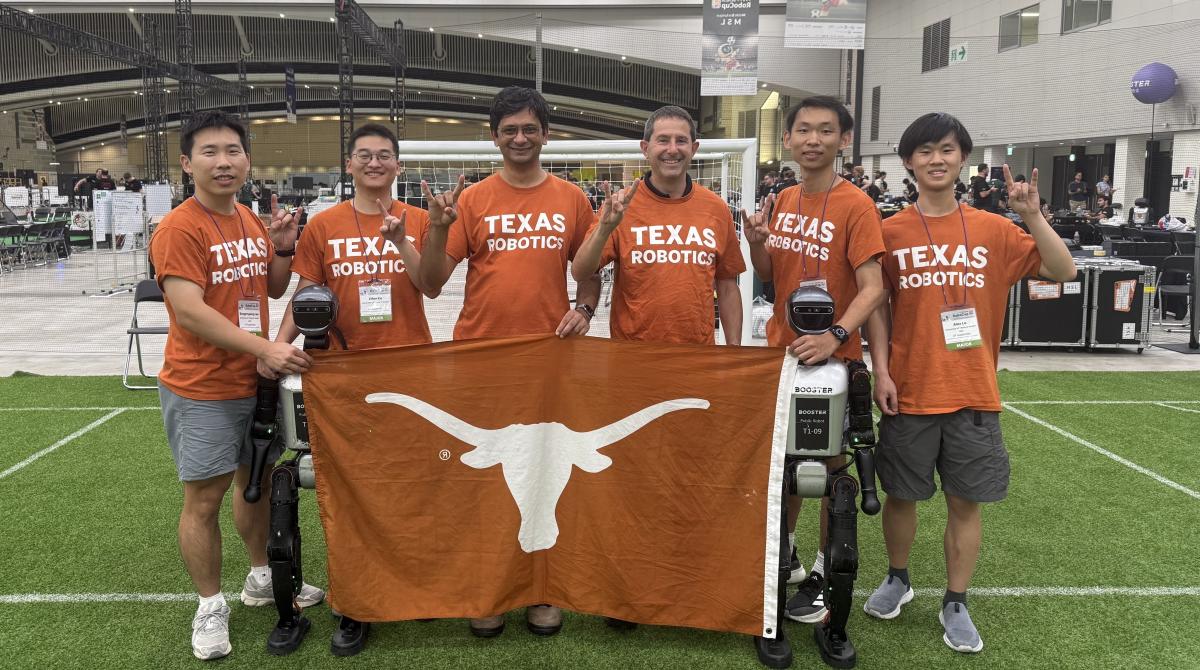
UT Austin Villa, the award-winning robot soccer team from Texas Robotics, recently returned from Incheon, South Korea, where they competed in RoboCup 2026, the world’s largest and most prestigious robotics competition. The team, led by professors Peter Stone and Joydeep Biswas, is made up of three PhD students and three undergraduates. This was the second year that UT Austin Villa participated in a humanoid division, building on a 20-year history of success that included dominant runs in the 3D Simulation League and a Standard Platform League world championship in 2012.
Competition Parameters
The competition in South Korea featured 3v3 matches. Each robot had to carry out a specific role: one served as goalie, and the other two acted as strikers. Coordination between them was handled not by a human operator during the game but was coded in advance of the matches; however, it was not a fixed script. The team coded the foundational AI, computer vision, and game theory. During a game, the robots acted completely on their own, using reinforcement learning to perceive the ball, navigate the field, and adapt to opponents in real time.
RoboCup 2026 also saw several major changes to the Humanoid Soccer League. Most notably, the former Humanoid League and Standard Platform League were merged into a single, unified Humanoid Soccer League. Also, numerous teams were using the Booster T1 robot, originally designed for the Adult Size division. As a result, the number of participating teams ballooned from just four teams in 2025, to 22 teams this year, making the tournament far more competitive than in the past.
UT Austin Villa encountered two major differences between their home field in the Gates-Dell Complex (GDC) at UT Austin, and the actual environment at RoboCup. First, the RoboCup soccer field was significantly larger and more open, which exposed weaknesses in their localization system and game logic; searching for the ball, for instance, became much more difficult on the expanded field. Second, while the team had primarily tested using their own two robots at GDC, fielding a full 3v3 team required them to borrow an additional robot from a shared pool. Because this borrowed robot featured different cameras and firmware versions, the team spent much of the first two days adapting their software to the new hardware and the competition field.
UT Austin Villa Results
UT Austin Villa lost their opening match against CAU Mountain & Sea by a score of 0–1, as the opponent played a highly defensive game that prevented the Villa striker from finding a clear shooting opportunity. However, the team performed much better over the following two days, rebounding to finish the group stage with four wins and one draw. A major highlight came in the quarterfinals, where UT Austin Villa defeated HTWK Germany, a historically dominant RoboCup humanoid team, to advance to the semifinals.
While the semifinal and third-place matches proved unfortunate, UT Austin Villa ultimately secured an impressive 4th-place finish out of the 22 competing teams, successfully advancing research in perception, locomotion, and multi-robot coordination while picking up fans along the way.
RoboCup 2026 provided critical takeaways for future research. The team noted that testing their game logic more thoroughly in simulation would have saved considerable debugging time during the event; for example, their indirect free-kick logic had repeatedly attempted to pass the ball to a teammate even when no other teammates were on the field. Additionally, the team identified a need to optimize striker behavior, observing that the robot spent too much time aligning itself with the ball-to-goal direction before shooting, which frequently gave opposing defenders enough time to block the shot.
Get a kick out of robotics? Visit Texas Robotics to learn more about robotics research, education, and innovation at UT Austin.