The U.S. Department of Energy (DOE) recently launched its landmark $293M Genesis Mission—a national initiative that will combine artificial intelligence, supercomputing, and scientific instrumentation into the world’s most powerful integrated research discovery platform. Out of more than 5,000 applications nationwide, five teams at UT Austin earned funding, positioning UT at the forefront of AI-driven scientific innovation.
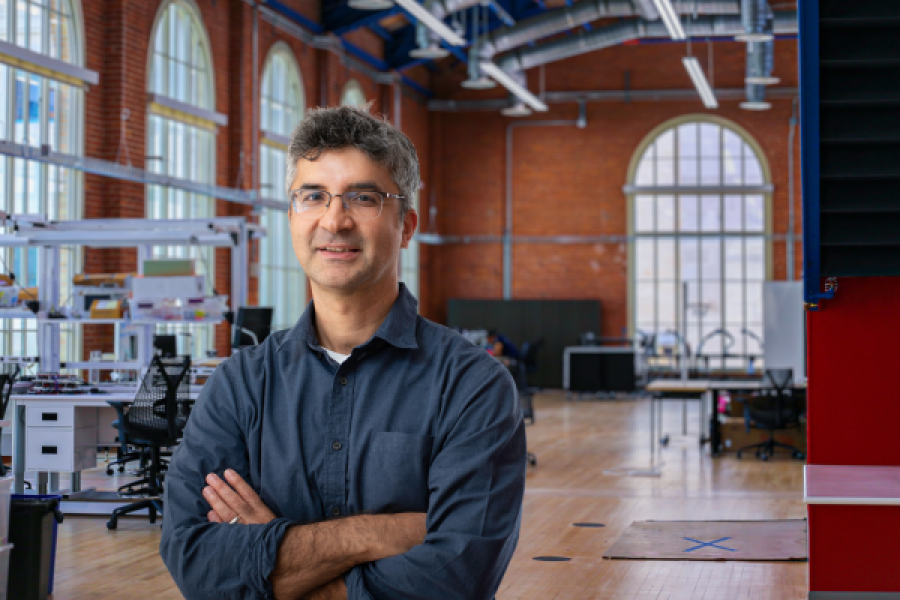
Volkan Isler, professor in the Department of Computer Science and a core faculty member of Texas Robotics is leading SAFE-BOLT (Safety-Assured Force-Aware Execution for Bimanual Operations on Lab Tools) with the goal of solving one of the most persistent bottlenecks in modern research: the physical labor required to conduct laboratory experiments.
Human Dexterity vs. Automation
Physical experimentation is part and parcel of scientific methods, but it is intensely labor-intensive and repetitive. While dedicated machinery can automate standardized industrial processes, research workflows in the lab still rely heavily on human dexterity and adaptability.
"Humans can be gentle and precise enough to spread a liquid solution on a glass plate,” says Volkan Isler, “and, at the same time, strong enough to turn a jammed microscope knob or secure the fasteners of a reactor housing using a lot of force."
Building general-purpose robots capable of replicating this nuanced "force awareness" represents a pinnacle in current robotics research. Beyond managing variable forces, robotic assistants face severe sensory obstacles in lab environments, such as identifying transparent glassware or navigating reflective metallic surfaces. Integrating solutions to these individual perception and control problems into a single, cohesive system is a central goal of SAFE-BOLT.
Building the Physical Infrastructure
In Phase I of the Genesis project, Isler's team will build a dedicated research lab equipped with advanced robotics and specialized sensors. The system will capture detailed data on how people perform tasks, providing accurate measurements that researchers can use to train and test AI-powered robots.
To evaluate performance in real-world settings, the team has targeted two core tasks:
- Materials synthesis and assembly workflows, developed in close collaboration with the Materials Discovery Research Institute (MDRI).
- Microscope-centered optofluidics experimentation, inspired by research led by UT mechanical engineering professor Yuebing Zheng.
By deploying baseline robotic assistants powered by current state-of-the-art algorithms on this testbed, researchers can systematically document current system limitations, laying the foundation for advanced, Phase II research efforts.
Interdisciplinary Collaboration That Drives Real-World Impact
Cross-disciplinary collaboration is a key strength of SAFE-BOLT. Partnering with MDRI brings deep materials science expertise and real-world performance requirements directly to the engineering team. Additionally, industry partner Medra AI, a startup specializing in robotic platforms for continuous scientific experimentation, will bring commercial perspective to the project’s platform design.
"UT is a world leader in both robotics and materials science," says Isler. "Bringing together researchers from these two strengths, along with our industry partners, creates unique opportunities for innovation."
While near-term outcomes will address critical scientific workforce shortages by relieving researchers of tedious tasks, the ultimate goal is autonomous scientific discovery. While AI models can already generate scientific hypotheses and simulate outcomes, force-aware robotic systems complete the loop by physically conducting and validating experiments in the real world.
Through the DOE Genesis Mission, UTCS researchers are helping bridge the gap between artificial intelligence and physical execution, and paving the way for safer, faster, and fully automated scientific breakthroughs.
Learn more about the Department of Energy’s Genesis Mission and stay up to date on the team’s progress at Texas Robotics.