Research

AI Brain Decoder Moves Closer to Real-World Use for People With Aphasia

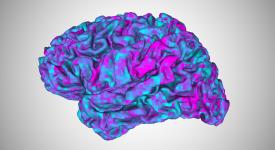
Brain activity like this, measured in an fMRI machine, can be used to train a brain decoder to decipher what a person is thinking about. In this latest study, UT Austin researchers have developed a method to adapt their brain decoder to new users far faster than the original training, even when the user has difficulty comprehending language.

02/07/2025 - UT Austin researchers have improved their AI-powered brain decoder, allowing it to translate thoughts into continuous text with just one hour of training—far less than the original 16-hour process. This advancement makes the technology more accessible, particularly for individuals with aphasia, by enabling communication without requiring spoken language comprehension. The team is now collaborating with experts in aphasia research to explore its potential for real-world applications.

The Future of AI Research: UT's Adam Klivans on KXAN

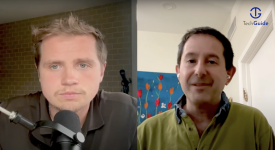
UT Professor Adam Klivans on the KXAN set

01/31/2025 - Dr. Adam Klivans, UT Computer Science professor and director of the Institute for Foundations of Machine Learning, joined KXAN Austin to discuss the impact of DeepSeek’s latest AI model. He explained how the Chinese company’s breakthrough in training efficiency—achieving high-performance results with significantly less computational power—has surprised the AI industry and affected major tech stocks. Klivans also highlighted ongoing questions about DeepSeek’s methods and the broader implications for AI development.

Researchers Reduce Human Effort in Robot Training

Limestone color background with duotone burnt orange Gr-1 robot on right with "How to Train Humanoid Robots More Efficiently" on left.

12/17/2024 - The Robot Perception and Learning Lab launched DexMimicGen, a new data generation system to improve training for humanoid robots. It builds on the lab’s earlier system, MimicGen, to predict humanoid autonomous robot movements from a small set of human demonstrations.

On AI for the Rest of Us: How AI is Accelerating Discovery

A woman in a white lab coat and gloves holds up a molecule that has been magnified to the size of her head

12/03/2024 - From data analysis, code writing, summarizing scientific literature and even designing experiments, researchers across disciplines are using AI tools to aid in their research.Adam Klivans, a professor of computer science and Alex Dimakis, a computer and electrical engineering professor, co-direct the Machine Learning Lab and the Institute for Foundations of Machine Learning. Together with Marc Airhart and Casey Boyle discuss how artificial intelligence plays an increasingly important role in the latest scientific discoveries.

On AI for the Rest of Us: Rise of LLMs

Image generated with Midjourney, a generative AI tool. Photo-Illustration: Martha Morales

12/03/2024 - Large-Language Models like ChatGPT, Google Gemini, and Claude exploded into the mainstream a few years back. Now, associate CS professor Greg Durrett talks with co-hosts Marc Airhart and Casey Boyle about the future of these LLMs. Will they eventually get too good and take our jobs? What about disinformation?

Introducing: AI for the Rest of Us

Two people look at a wall emblazoned with the words "AI for the rest of us"

12/03/2024 - A new podcast, made in collaboration with the College of Natural Sciences and the College of Liberal Arts, will answer the burning questions in all things artificial intelligence. Guests from across campus will engage in conversations with co-hosts Marc Airhart, a science communicator for CNS and Casey Boyle, associate rhetoric professor and Digital Writing and Research Lab Director. 

On AI for the Rest of Us: AI + Energy

Three speakers at a panel discussion

12/03/2024 - While AI uses mass amounts of energy, it can also make energy systems more sustainable, efficient and safer. In front of a live audience, three experts in the field talk about AI and energy, as a part of a symposium hosted by the LBJ School of Public Affairs at The University of Texas at Austin.

‘To do things they hadn't even thought of’: Senior Turing Scholar publishes second computer science research paper

Turing student Alan Baade pictured in gray and white against geometic print on white background and orange soundwaves running behind Alan's head.

10/01/2024 - Computer Science and Mathematics senior Alan Baade really enjoys spending hours on problems.Especially the particularly hard ones, he said. Spending 40 hours on one equation with a small break for sleep somewhere in the middle is rewarding to him.“I think it's because you can tell at the end of this you are going to understand the material,” Baade said.  “You're going to understand computers.”

Keeping Up with AI’s Increasingly Complex Networking Demands

Daehyeok Kim, Aditya Akella, and Venkat Arun against an abstract background of shapes.

09/24/2024 - The job of building computer networks that train and run large AI models is becoming increasingly complicated because traditional network designs can’t operate at the higher speeds that the AI workloads require and need to be tuned to a variety of communication endpoints (such as CPUs, graphics processing units and AI accelerators) that have widely different characteristics, including data generation speeds. Moreover, AI workloads require advanced network monitoring capabilities to quickly diagnose and resolve performance bottlenecks.

New AI Institute Led by UT Researchers Will Accelerate Cosmic Discovery

Four quadrants of scientific-images come together, with webs showing bright spots for star formation, galaxy clustering, identifications of galaxies that are labeled and a futuristic network.

09/18/2024 - The University of Texas at Austin has been selected to lead the NSF-Simons AI Institute for Cosmic Origins, a new $20 million research initiative focused on using AI to explore the universe’s biggest mysteries, from dark matter to the origins of life. Greg Durrett, Associate Professor of Computer Science at UT, is a co-investigator on this groundbreaking project, further cementing UT’s leadership in AI research.