Research

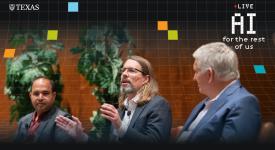
Podcast: Is it Time to Regulate AI?

A statue of a blindfolded woman in a toga holding a scale in one hand and a sword in the other, representing the legal system

09/12/2024 - Artificial intelligence is very loosely regulated in the U.S. What kinds of laws would help make AI safer and more useful for everyone?

UT Computer Science Professor Trains AI Through Game Theory

Computer scientists Ryan Farell and Chandrajit Bajaj standing side-by-side in front of the visualization wall in the POB Vis Lab.

08/30/2024 - Computer science professor Chandrajit Bajaj was recently awarded funding by the U.S. Army Futures Command’s University Technology Development Division (UTDD), in support of DEVCOM C5ISR, for game theory research to develop artificial intelligence systems. The project will utilize Dynamic Belief Games to train AI agents to be better planning and decision support tools for next-generation communications systems.

Texas RoboCup Team on KXAN

NAO Humanoid robots playing soccer in the Intelligent Robotics lab in the UT Computer Science Gates Dell Complex.

08/12/2024 - Are AI robots the future of sports? These UT students think soAustin (KXAN) — A team of UT students, led by Professor Peter Stone, recently triumphed at the RoboCup Home competition in the Netherlands, where their AI-powered robots autonomously played soccer. The students believe their research is paving the way for a future where robots can compete against humans in sports, revolutionizing the field of AI robotics.

UT computer science lab announces way to make short-form content more accessible

Amy Pavel standing outside on UT Austin campus in a black button down shirt smiling at the camera.

08/09/2024 - The UT computer science lab, with faculty member Amy Pavel and recent graduate Tess Van Daele at the forefront, has developed an AI system called ShortScribe to enhance accessibility for visually impaired users of short-form videos on platforms like TikTok and Instagram Reels. Pavel, an assistant computer science professor and co-author of the research paper, explained that the system utilizes AI technologies such as Optical Character Recognition, Automatic Speech Transmission, and GPT-4 to segment videos, transcribe speech, and create detailed audio descriptions.

Transforming Video Accessibility Through Artificial Intelligence

Smart phone positioned on a phone tripod in a netural-tone, naturally lit room with a large window in the background.

06/27/2024 - Digital media is one of the best ways to engage with new communities, where each click takes you to new, engaging platforms like TikTok, Instagram Reels, and YouTube Shorts. This content is enhanced when you consider the intricacies of webcam visuals and overlays making it a really immersive experience.  Now, imagine this experience if you’re unable to see the video. For people with visual impairments, accessing this content comes with many challenges. These platforms currently lack effective solutions to bridge the accessibility gap for the blind and low vision (BLV) community.

UT Computer Science Students Win Prestigious NSF Graduate Research Fellowships

Three students working in a computer science lab together looking at a segway robot.

05/20/2024 - The National Science Foundation (NSF) has announced the recipients of its prestigious Graduate Research Fellowships (NSF GRFP) for 2024, and students from the Department of Computer Science at The University of Texas at Austin's College of Natural Sciences (CNS) have been prominently recognized. This year, four Computer Science students were honored with fellowships or honorable mentions, highlighting their outstanding contributions and potential in various cutting-edge research areas.

Artificial Intelligence Trained to Draw Inspiration From Images, Not Copy Them

Three rows of similarly themed illustrations—earnest dogs, scientist pandas and robot graffiti—differ in each of five iterations per row.

05/17/2024 - Researchers are using corrupted data to help generative AI models avoid the misuse of images under copyright. Powerful new artificial intelligence models sometimes, quite famously, get things wrong — whether hallucinating false information or memorizing others’ work and offering it up as their own. To address the latter, researchers led by a team at The University of Texas at Austin have developed a framework to train AI models on images corrupted beyond recognition.