Research

New Materials Could Lead to Computers That Work Like the Human Brain

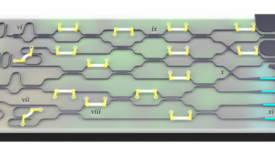
Mock-up of a quantum photonic device, which could form part of a neuromorphic computing system. From Silverstone et al., IEEE J. Sel. Top. Quantum Electron. 22, 6 (2016). Licensed under a Creative Commons Attribution 3.0 License.

09/14/2021 - For decades, computer chips have gotten denser, faster and more energy efficient. But in recent years, those improvements have slowed to a crawl.Yet some of the most exciting new applications engineers are exploring — self-driving cars, microscopic robots to diagnose and treat diseases inside the human body, and systems collecting environmental data for battlefield awareness or public health forecasting — need fast, compact, energy-efficient computer chips that can be integrated directly into these systems, rather than relying on connecting to supercomputers far away.

Kristen Grauman Rethinks How Floor Plans are Created

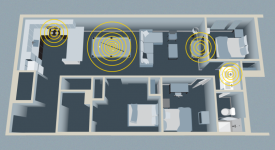
Aerial view of gray scale home layout with sound wave graphics in yellow

07/22/2021 - Floorplans are used in many industries to help people visualize what the inside of a building looks like without actually seeing it. Traditionally, floorplans have been created by actually observing a 3D environment either manually or with the aid of 3D sensors. But what happens when the luxury of observing the 3D environment isn’t available—for example, when a robot is introduced to a new environment? Would it be able to quickly create floor maps without actually seeing the entire environment being mapped in detail?

Yaskawa Partnership Accelerates Robotics Research at The University of Texas at Austin

Dr. Chetan Kapoor with a dual-arm, SDA10F robot

04/05/2021 - Yaskawa, a global manufacturer of servos, motion controllers, AC motor drives, switches, and industrial robots, is establishing a partnership with The University of Texas at Austin. This partnership is marked with a gift of a dual-arm, SDA10F robot that will be available for the use of the Texas Robotics faculty. The partnership aims to facilitate interdisciplinary research and innovation within the robotics community in the university.

Exploring Passive RFID Tag Use For Sensory Technology

Dr. Swadhin Pradhan and Professor Lili Qiu

03/03/2021 - When was the last time you changed out a battery in your house? Studies show that battery-powered devices are used substantially in modern times, Americans use nearly 3 billion batteries every year. Batteries are currently popular because they are able to make electric devices, such as flashlights and watches, portable. However, our usage of batteries extends further from just portable electronic devices.

Bridging the Gap Between Industry and Academia

Illustration of automated car driving down three lane road, sensing cars around it.

01/14/2021 - UT Austin collaborates with Bosch to drive automated research Texas Computer Science has recently launched a collaborative research partnership sponsored by Bosch to explore new frontiers of research on reinforcement learning for automated driving. The partnership was envisioned by Professor Peter Stone of the UTCS faculty and Dr. Kay Stepper, the Senior VP who oversees Bosch’s automated driving efforts in North America.

Alumni Gift Launches New AI Institute

Zaib And Amir Husain Photo by: Sloan Breeden

11/06/2020 - This fall, the National Science Foundation selected The University of Texas at Austin — a world leader in artificial intelligence research — to lead a new, $20 million national institute for machine learning.  

Mission Accomplished

Anna Hiss Gym Ribbon Cutting

11/05/2020 - UT Austin is committed to working with the U.S. military to identify and prioritize research that can quickly be adapted to help protect and defend the nation’s interest.

UT Scientists Use AI to Find Tourist Movement Patterns in Cuzco, Peru

10/28/2020 - We live in an increasingly digital era. Research shows that the average American checks their phone about 58 times daily, and spends an average of 4.5 hours a day on their phone. Without a doubt the amount of time the modern-day person spends on their phones has changed many aspects of how our society functions. For example, in the past decade we have seen a dramatic shift in forms of advertising.

Artificial Intelligence Revs Up Evolution’s Clock (Audio)

Hyenas mobbing a lion

10/14/2020 - Evolutionary biologists never have enough time. Some of the most mysterious behaviors in the animal kingdom—like parenting—evolved over thousands of years, if not longer. Human lifespans are just too short to sit and observe such complex behaviors evolve. But computer scientists are beginning to offer clues by using artificial intelligence to simulate the life and death of thousands of generations of animals in a matter of hours or days. It's called computational evolution.

Mobile Robotics Lab Reaches Milestone in Campus-Scale Autonomous Navigation

The UT Campus-Jackal (left) and the UT Campus-Husky (right)

10/06/2020 - A group of Texas Computer Science (TXCS) researchers from the Autonomous Mobile Robotics Laboratory (AMRL) comprising Joydeep Biswas, Sadegh Rabiee, Jarrett Holtz, Kavan Sikand, Max Svetlik, and John Bachman (UMass Amherst) have reached an incredible milestone in their research: deploying an autonomous robot that autonomously navigates on the campus-scale, resilient to everyday changes and varying conditions.