Research

Transforming Human-Robot Interaction Through Mood Inducing Music

Young person lounging back with a boombox under their right foot listening to music.

05/06/2024 - Music has always had the power to stir our emotions, from the exhilaration of a fast-paced rock anthem to the melancholy of a soulful ballad. But, could the music we listen to also affect how we make decisions, especially in our interactions with robots? This intriguing question lies at the heart of a study conducted by UT Austin Assistant Professor Elad Liebman and Professor Peter Stone.

Could a Robot Win the World Cup? UT Experts Explore Future of Automatons

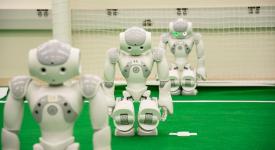
Three Nao humanoid robots lined up on RoboCup practice field.

04/19/2024 - UT Computer Science is at the forefront of robotics innovation, aiming to propel the field forward. Highlighted in a recent article by KXAN, experts like Dr. Peter Stone and Justin Hart showcased their work, including advancements in generative AI, which is integral to tasks ranging from domestic chores to humanoid robot soccer, a part of the RoboCup Federation's ambitious goal of a robot team winning the World Cup by 2050.

Understanding the Mathematical Foundations Behind Challenging Puzzle Design

image of a disentanglement puzzle. A blue square with a three by three grid with a red donut looped around one of the grid lines of the square. View from top and view from bottom.

02/01/2024 - Researchers from The University of Texas at Austin and McGill University delve into the mathematical intricacies of wire puzzle design. Focusing on geometrical aspects, they establish criteria for puzzle characteristics, emphasizing the importance of a challenging experience. The team introduces quantitative metrics to assess tunnel-bubble structures, demonstrating their effectiveness in distinguishing puzzles from non-puzzles. Their findings provide a foundation for an optimization model, shaping the future of wire puzzle design.

Unlocking the Power of Bilevel Optimization: BOME

A night view of a city scene with multiple highway overpasses overlapping.

11/08/2023 - In mathematical optimization, a new approach is emerging, promising to transform how we tackle intricate challenges across various domains. Consider the complexity of bilevel optimization, a problem that has confounded experts in machine learning, engineering, and other fields. Recent advances are providing new insights into this intricate landscape, presenting a streamlined technique that has the potential to significantly enhance our ability to navigate these complex problems.

Paving the Way for a New Era in Crash Consistency Testing

a chipmunk stuffing peanuts into its cheeks

09/27/2023 - The work of researchers from The University of Texas at Austin’s Department of Computer Science in crash consistency has yielded a breakthrough innovation—the Chipmunk system. At its core, Chipmunk zeroes in on a crucial mission—meticulously testing file systems to identify and tackle crash consistency bugs that can significantly impact data integrity and system reliability. The UT Austin team has produced a promising solution that could pave the way for a new era in data storage and stability.

Brain Activity Decoder Can Reveal Stories in People’s Minds

Alex Huth (left), Shailee Jain (center) and Jerry Tang (right) prepare to collect brain activity data in the Biomedical Imaging Center at The University of Texas at Austin. The researchers trained their semantic decoder on dozens of hours of brain activity data from participants, collected in an fMRI scanner. Photo Credit: Nolan Zunk/University of Texas at Austin.

05/01/2023 - The work relies in part on a transformer model, similar to the ones that power ChatGPTA new artificial intelligence system called a semantic decoder can translate a person’s brain activity — while listening to a story or silently imagining telling a story — into a continuous stream of text. The system developed by researchers at The University of Texas at Austin might help people who are mentally conscious yet unable to physically speak, such as those debilitated by strokes, to communicate intelligibly again.

A More Efficient Future For Neural Network Systems

layers of wood representing layers of data

04/21/2023 - UT Computer Science Ph.D. Garrett Bingham’s research under Professor Risto Miikkulainen in smart automated machine learning has made significant steps toward more efficient neural network systems.