
Faculty

Could Robots Compete in the 2050 World Cup? This UT Team Thinks It’s Possible
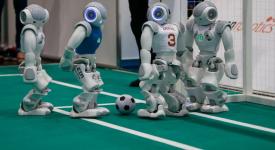
07/26/2018 - By Rachel Cooper, The Alcalde For the past month, the world has been watching national soccer teams from across the globe compete in a surprising and nail-biting World Cup. Although the U.S. didn’t make the cut for the 2018 version of the quadrennial tournament, there’s an unorthodox soccer team close to home that did pretty well on the international stage—a group of Longhorns and their goal-scoring robots.


Linear Algebra Foundations to Frontiers - Programming for Correctness Online Course Launches Second Offering

05/15/2018 - The only effective way to raise the confidence level of a program significantly is to give a convincing proof of its correctness. But one should not first make the program and then prove its correctness, because then the requirement of providing the proof would only increase the poor programmer’s burden. On the contrary: the programmer should let correctness proof and program grow hand-in-hand. - “The Humble Programmer,” Edsger W. Dijkstra (1972)

These Mathematical Techniques Could Help Design Shape-shifting Materials

A snapdragon flower petal grown from a cylinder. In each state, the colors show the growth factors of the top (left) and bottom (right) layer, and the thin black lines indicate the direction of growth. The top layer is viewed from the front, and the bottom layer is viewed from the back, to highlight the complexity of the geometries. (Credit Harvard SEAS)

05/08/2018 - UT College of Natural Sciences News | October 16, 2017 Nature has a way of making complex shapes from a set of simple growth rules. The curve of a petal, the swoop of a branch, even the contours of our face are shaped by these processes. What if we could unlock those rules and reverse engineer nature's ability to grow an infinitely diverse array of shapes?

UT Competitive Programming Team Goes to ACM-ICPC World Finals

04/26/2018 - On Thu, 19 Apr 2018, the UT Competitive Programming team competed at the ACM-ICPC World Finals at Peking University in Beijing, China. The competition consisted of teams from 140 regions (approx. 420 students) trying to solve 11 problems in 5 hrs and 20 min. The first-place team, Moscow State University, solved 9 problems. UT solved 4 problems and tied with 42 other teams for 56th place.