Research

Computer Scientists Receive $1.7 Million Grant to Make Chip Design Easier

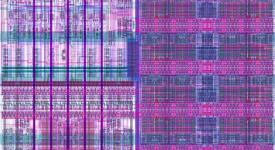
An "Asynchronous FPGA chip" built using the tools Keshav Pingali and his collaborators are developing for DARPA.

10/03/2018 - Researchers at the University of Texas at Austin, Yale University and Texas State University have been awarded $5 million by the Defense Advanced Research Projects Agency (DARPA) as part of a program designed to spark the next wave of semiconductor innovation and circuit design in the U.S.

Major Quantum Computing Advance Made Obsolete by UT Grad

07/31/2018 - Ewin Tang, a 2018 University of Texas at Austin graduate in computer science and mathematics, is receiving national attention for a feat accomplished at the age of 18 by disproving, as part of an honors thesis, a widely held assumption about the hottest next-thing in technology, quantum computing. ​As Quanta magazine explains in an article out today, Tang's accomplishment involved showing that ordinary computers could, in fact, solve a pro

Could Robots Compete in the 2050 World Cup? This UT Team Thinks It’s Possible

07/26/2018 - By Rachel Cooper, The Alcalde For the past month, the world has been watching national soccer teams from across the globe compete in a surprising and nail-biting World Cup. Although the U.S. didn’t make the cut for the 2018 version of the quadrennial tournament, there’s an unorthodox soccer team close to home that did pretty well on the international stage—a group of Longhorns and their goal-scoring robots.

These Mathematical Techniques Could Help Design Shape-shifting Materials

A snapdragon flower petal grown from a cylinder. In each state, the colors show the growth factors of the top (left) and bottom (right) layer, and the thin black lines indicate the direction of growth. The top layer is viewed from the front, and the bottom layer is viewed from the back, to highlight the complexity of the geometries. (Credit Harvard SEAS)

05/08/2018 - UT College of Natural Sciences News | October 16, 2017 Nature has a way of making complex shapes from a set of simple growth rules. The curve of a petal, the swoop of a branch, even the contours of our face are shaped by these processes. What if we could unlock those rules and reverse engineer nature's ability to grow an infinitely diverse array of shapes?